01
Can the Passenger Walk?
A passenger who can walk independently or with limited assistance may only require ambulatory medical transportation rather than an accessible wheelchair or stretcher vehicle.
Families often begin searching for medical transportation after a hospital discharge, change in mobility, surgery, injury, or when an older relative can no longer safely use an ordinary passenger vehicle.
The most important question is not simply whether transportation is available. It is determining which type of transportation matches the passenger’s actual mobility, transfer ability, positioning needs and pickup environment.

This guide explains how different transportation options work. If you are looking for scheduled private-pay transportation, visit our Non-Emergency Medical Transportation in Centreville, VA service page for wheelchair, stretcher, ambulatory, hospital discharge, bed-to-bed and qualifying long-distance transportation options.
Two passengers traveling to the same medical office may require completely different transportation arrangements. Mobility and transfer ability usually matter more than the destination itself.
A passenger who can walk independently or with limited assistance may only require ambulatory medical transportation rather than an accessible wheelchair or stretcher vehicle.
A wheelchair passenger generally must be able to tolerate an upright seated position. A passenger who cannot safely remain seated may need a different transportation option.
Transfer ability matters when deciding whether a passenger can move between a bed, chair, wheelchair or transportation surface and what level of planning may be required.
These transportation types are related, but they serve different passenger needs.
Families sometimes assume that anyone who spends most of the day in bed automatically requires stretcher transportation. That is not necessarily the case.
A passenger may spend substantial time in bed but still be able to transfer to a wheelchair and remain safely seated for transportation. Another passenger may be unable to tolerate an upright position and require a different transportation arrangement.
The decision should be based on the passenger’s actual mobility, transfer ability, positioning needs and trip requirements rather than the label “bedridden” alone.
Being medically cleared for discharge does not necessarily mean a passenger can comfortably enter a family car or rideshare vehicle.
After surgery, illness or hospitalization, the passenger may have new mobility limitations, weakness, difficulty transferring, wheelchair use or positioning needs that affect the transportation decision.
Discharge transportation may involve travel home, to rehabilitation, a skilled nursing facility, assisted living community or another appropriate receiving location.
A transportation vehicle can be appropriate for the passenger, but access conditions at the residence or destination can still create complications if they are not discussed beforehand.
Standard transportation can work well when a passenger can independently enter and exit an ordinary vehicle and does not require specialized mobility equipment.
A different transportation option may need to be considered when the passenger uses a wheelchair, cannot transfer independently, cannot remain safely seated or requires more planning at the pickup or destination.
UniqueHands provides private-pay non-emergency medical transportation. Families, passengers, caregivers and facilities can contact the company directly regarding a transportation request.
Pricing can vary because wheelchair, stretcher, ambulatory, bed-to-bed and long-distance transportation may involve different vehicles, equipment, distances and trip requirements.
Medicare, Medicaid or private insurance should not be assumed to automatically pay for a requested private transportation service.
A longer medical transportation trip may require more preparation than a short local appointment.
Families may need to consider travel time, passenger positioning, restroom or comfort needs where applicable, destination procedures, pickup timing and whether a return trip is required.
Long-distance transportation can sometimes involve travel elsewhere in Virginia or to another state depending on the requested trip and availability.
For service-specific information, visit our main Long-Distance Medical Transportation page.
Complete information can make it easier for a transportation provider to understand the requested trip and determine what transportation arrangement may be appropriate.
This article is intended to help families understand the differences between transportation options.
For actual Centreville service information, transportation availability, local trip planning and scheduling, continue to our official Non-Emergency Medical Transportation in Centreville, VA page.
Visit the appropriate primary service page for more detailed information about a specific transportation type.
The appropriate transportation type depends on mobility, ability to transfer, ability to remain seated, wheelchair use, positioning needs, pickup access and destination requirements. The transportation provider should review these details before the trip is confirmed.
Not necessarily. Some passengers who spend substantial time in bed may still be able to transfer to a wheelchair and remain safely seated. Others may require stretcher transportation because they cannot tolerate an upright position.
Scheduled non-emergency transportation may be considered after a passenger has been medically cleared for discharge but cannot appropriately use ordinary transportation.
Stairs, elevators, narrow hallways, entrances and room location can affect passenger movement and the transportation plan. These conditions should be disclosed before the trip.
Yes. UniqueHands provides private-pay non-emergency transportation. Families should not assume Medicare, Medicaid or private insurance automatically pays for a requested service.
Visit the Non-Emergency Medical Transportation in Centreville, VA page for the official Centreville service information and transportation request options.
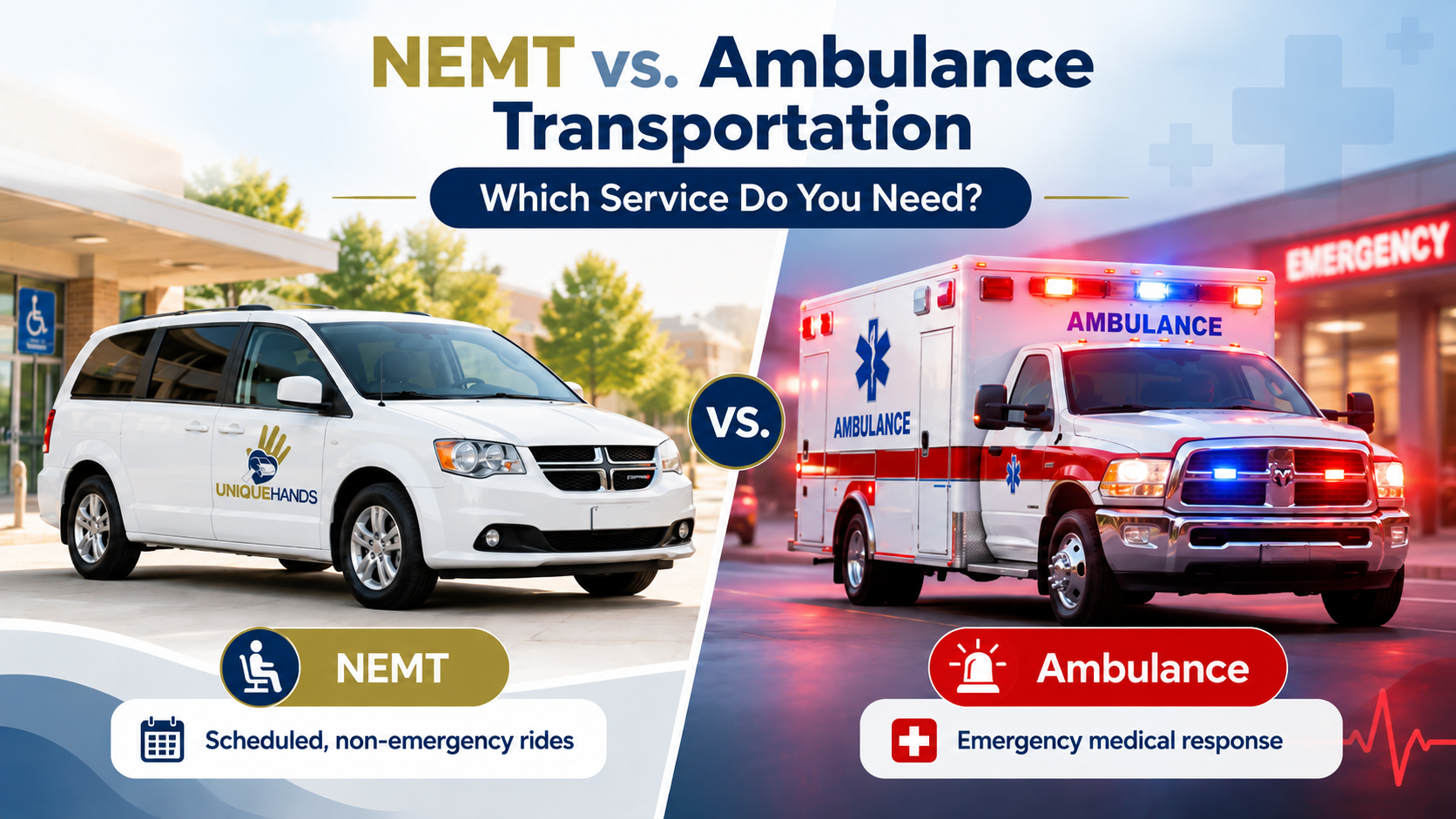
No. Non-emergency medical transportation is scheduled transportation and does not replace emergency ambulance care. Anyone experiencing a medical emergency or requiring immediate emergency intervention should call 911.
If you are ready to arrange transportation, visit our official Centreville service page or provide the passenger’s mobility, pickup, destination, requested date and time, wheelchair or stretcher needs and access information.
UniqueHands provides scheduled private-pay non-emergency medical transportation. For a medical emergency, call 911.
UNIQUEHANDS RESOURCES
Explore practical guides for families, caregivers, and facilities planning wheelchair, stretcher, ambulatory, hospital discharge, long-distance, and state-to-state non-emergency medical transportation.