Planning State-to-State Patient Transfers With the Right Transportation and Assistance
When someone needs to travel from a hospital, rehabilitation center, nursing facility, or residence to a destination in another state, the transportation arrangement should match their individual mobility requirements.
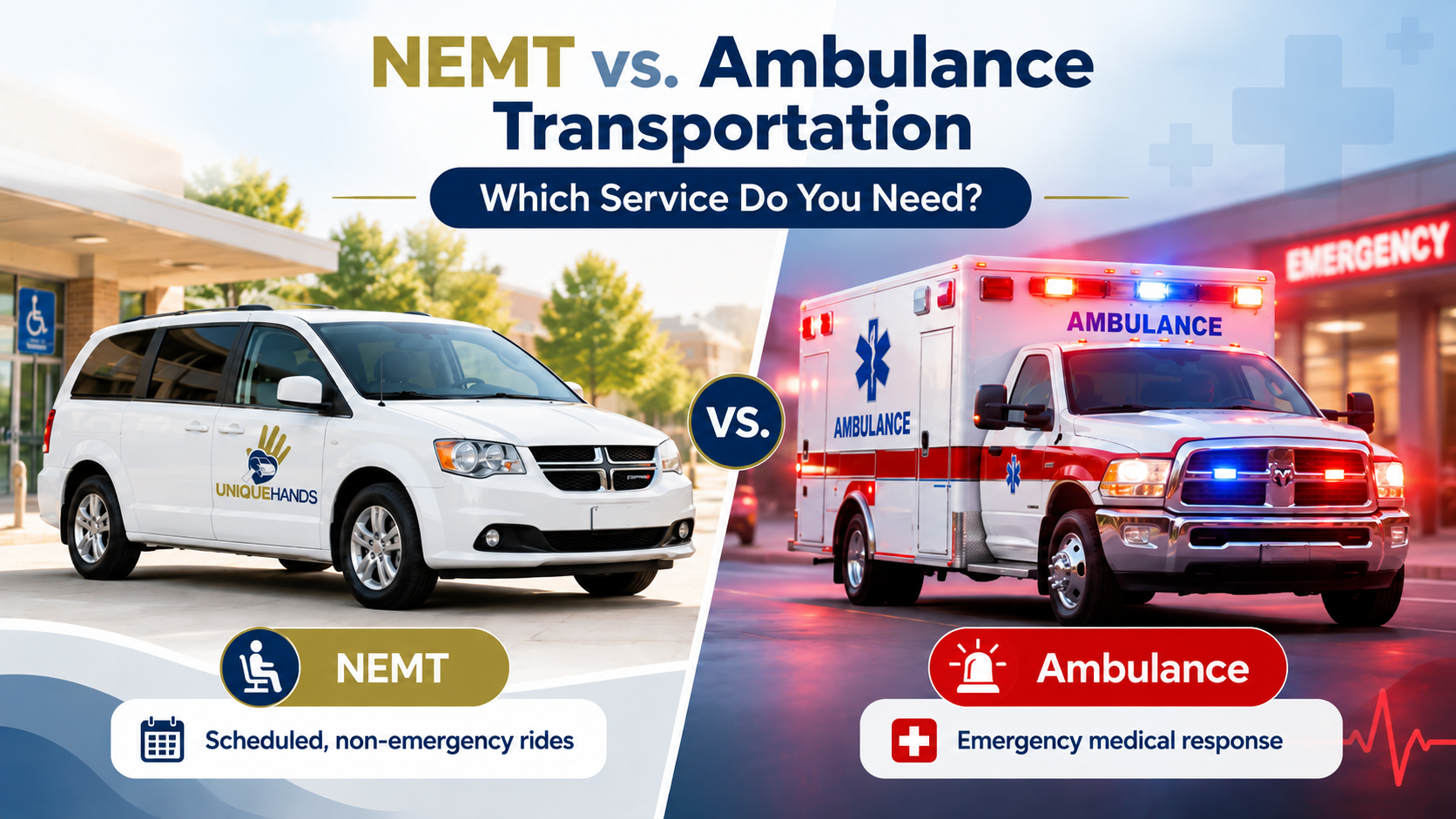
This guide explains wheelchair and stretcher transportation, bed-to-bed assistance, destination coordination, and the important differences between non-emergency patient transport and ambulance care.
What Is a State-to-State Patient Transfer?
A state-to-state patient transfer involves moving a person from one location to another across state lines, often in connection with healthcare, rehabilitation, residential care, or family relocation.
Some passengers can travel seated with modest mobility assistance. Others use wheelchairs, require stretcher transportation, or need help moving between beds and transportation equipment.
The most appropriate transportation method depends on mobility, positioning, destination access, travel duration, and whether the passenger is suitable for non-emergency ground travel.
UniqueHands provides private-pay, pre-arranged long-distance medical transportation based in Northern Virginia, including qualifying interstate journeys and assisted transportation.

Stretcher, Wheelchair, or Ambulatory Transportation: Which Is Appropriate?
The best transportation option is based on how the passenger can safely and comfortably travel for the planned journey.
Wheelchair Transportation
For passengers who remain in a wheelchair during travel and require accessible vehicle entry and appropriate securement.
Stretcher Medical Transport
For qualifying non-emergency passengers who need to travel in a lying position rather than seated upright.
Ambulatory Transportation
For passengers who can walk and enter a vehicle but benefit from scheduled transportation or assistance by arrangement.
Choosing the right service: Mobility assistance and transportation positioning are different from nursing supervision or emergency medical care. The passenger must be suitable for the requested non-emergency service.
Can a Patient Be Transported in a Hospital Bed?
When families arrange medical transportation, they sometimes ask whether a patient can travel in their existing hospital bed.
UniqueHands does not transport patients while they remain inside a hospital bed. A hospital bed is used for care and positioning in a hospital, facility, or residence. It is not the passenger transport equipment used in our vehicles.
For appropriate non-emergency stretcher transportation, the passenger may be transferred from a bed onto a transportation stretcher before entering the vehicle. Transfer arrangements must be evaluated in advance based on the passenger's needs, environment, and available support.
Hospital Bed
A hospital bed generally remains at the healthcare facility or residence. It is not loaded into a UniqueHands transportation vehicle with the patient.
Families arranging a hospital-to-home journey should discuss whether suitable transfer assistance is required before departure.
Transportation Stretcher
A transportation stretcher is equipment designed for appropriate passenger positioning and movement during a suitable non-emergency transport.
Whether a stretcher trip can be arranged depends on the passenger's condition, required assistance, and journey details.
Bed-to-bed does not mean the hospital bed travels. It describes assistance with appropriate transitions between the starting bed, transportation equipment, and the destination. Learn more about UniqueHands bed-to-bed transportation.
Understanding Bed-to-Bed Transportation During Patient Transfers
Bed-to-bed transportation may be requested when a passenger is unable to independently move between the starting location, transport equipment, and destination.
For example, a passenger leaving a rehabilitation facility may need additional help transitioning from a facility bed to a suitable transportation stretcher or wheelchair.
Upon arrival, the passenger may require assistance moving from transportation equipment to an appropriate destination, subject to the agreed service and safe transfer conditions.
UniqueHands evaluates requested transfer assistance before scheduling. Families should provide detailed information about passenger mobility, stairs, building entrances, elevators, and the receiving location.
Our guide to transportation for bedridden patients explains additional considerations for passengers with substantial mobility limitations.
Why Families Arrange State-to-State Patient Transfers
Hospital-to-Home Travel
Transportation after hospitalization when the passenger needs a suitable accessible vehicle to return home.
Rehabilitation Transfers
Scheduled transportation involving rehabilitation centers or appropriate post-acute care facilities.
Specialist Appointments
Longer-distance travel for consultations, evaluations, or treatment appointments outside the patient's home region.
Nursing Facility Transitions
Non-emergency transportation involving suitable nursing facilities, residential care, or assisted living destinations.
Returning Near Family
Interstate travel for passengers relocating closer to relatives who can provide ongoing personal support.
Special Mobility Needs
Travel requiring wheelchair access, stretcher positioning, or additional non-emergency assistance.
Planning Patient Transportation Across Virginia and State Lines
UniqueHands provides private-pay, pre-arranged medical transportation from communities throughout Northern Virginia, including Fairfax, Arlington, Alexandria, Springfield, Centreville, Reston, Herndon, Ashburn, Woodbridge, and Manassas.
A passenger may need a longer trip elsewhere in Virginia or a qualifying interstate journey involving Maryland, Washington, D.C., Pennsylvania, New Jersey, New York, North Carolina, or another destination.
Route examples do not guarantee trip availability. Requested transportation is evaluated based on mobility requirements, distance, scheduling, and other relevant conditions.
Within Virginia
Patient transfers may involve Northern Virginia pickup locations and destinations farther into the Commonwealth.
Families should discuss route length, mobility, destination access, and appropriate travel arrangements in advance.
Between States
Interstate transportation can involve medical appointments, recovery, facility transitions, and family relocation.
Read our article on long-distance medical transportation along the East Coast for additional regional travel planning.
What to Check Before a Hospital or Facility Transfer Across States
A successful transfer involves coordination at both the pickup and destination locations. Longer journeys require additional consideration of travel duration and passenger positioning.
Information About the Passenger
- Ability to walk or transfer
- Wheelchair dimensions if relevant
- Need for stretcher positioning
- Appropriate transfer assistance
- Ability to tolerate extended travel
- Companion or escort requirements
- Mobility equipment traveling along
Information About the Locations
- Full pickup and destination addresses
- Facility discharge instructions
- Receiving facility requirements
- Stairs, ramps, and elevators
- Building entrance accessibility
- Scheduled arrival arrangements
- Receiving caregiver or contact
Six Steps to Arrange Non-Emergency Interstate Medical Transportation
Identify the Journey
Share the starting location, destination, preferred travel date, and reason for the transportation.
Review Mobility Needs
Explain whether the passenger needs ambulatory, wheelchair, or stretcher transportation.
Discuss Transfer Assistance
Identify any help required between beds, wheelchairs, stretchers, and vehicle entry.
Confirm Location Access
Discuss stairs, elevators, hallways, loading areas, and facility arrival procedures.
Plan the Longer Route
Consider travel duration, passenger comfort, destination timing, and appropriate travel arrangements.
Review the Booking
Confirm availability, transportation type, requested assistance, private-pay pricing, and trip instructions.
When Is Non-Emergency Stretcher Transportation Appropriate?
Stretcher transportation can be an option for certain passengers who need to remain in a lying position but do not require emergency treatment during the journey.
It is not interchangeable with an ambulance, medical evacuation, or critical-care transportation.
Some passengers have medical needs that require nursing supervision, continuous clinical monitoring, or emergency resources. Those needs are outside the scope of scheduled non-emergency transport.
Important: UniqueHands does not provide emergency ambulance services, continuous clinical monitoring, or emergency medical treatment. For a medical emergency, call 911. If there is uncertainty about the appropriate level of transportation, consult the patient's care team before arranging the journey.
Escorts, Companions, and Assisted Patient Travel
Traveling across states can be an unfamiliar experience for someone with significant mobility limitations. Clear arrangements may help the passenger and family prepare.
UniqueHands offers companion and escort arrangements by advance request, depending on the passenger's requirements and trip configuration.
Family members should discuss whether a caregiver will accompany the passenger, whether additional mobility assistance is needed, and how the destination handoff will work.
For patients leaving a healthcare facility or returning after an outpatient appointment, details about discharge procedures and authorized escorts may also be important.
Our supporting guide to transportation after a colonoscopy in Fairfax discusses a different kind of pre-arranged outpatient travel.
What Affects the Cost of a State-to-State Patient Transfer?
An interstate transportation quote depends on the individual journey. Distance alone does not determine every transportation requirement.
Route and Travel Time
Longer journeys involve greater travel distance and additional transportation logistics.
Transport Configuration
Stretcher, wheelchair, ambulatory, and bed-to-bed arrangements may have different requirements.
Additional Assistance
Transfer needs, escorts, location access, and scheduling details may affect planning.
UniqueHands is a private-pay provider and does not bill Medicare, Medicaid, or insurance for transportation. Families can request a quote using the route, passenger mobility, and assistance details.
If you are comparing interstate transportation arrangements, our guide to state-to-state medical transportation planning offers additional cost considerations.
Supporting Patient Transportation From Northern Virginia
UniqueHands brings more than a decade of experience in non-emergency medical transportation and serves Northern Virginia with pre-arranged, private-pay ground transportation.
Our services include wheelchair transportation, stretcher medical transport, ambulatory transportation, bed-to-bed assistance, and long-distance medical transport.
Transportation is arranged according to the requested route, mobility needs, access conditions, and service availability.
Read more about UniqueHands or explore our full transportation services.
State-to-State Patient Transfer FAQs
Can UniqueHands transport a patient from Virginia to another state?
UniqueHands provides qualifying interstate non-emergency ground transportation. Availability depends on the requested route, passenger needs, and scheduling.
Can someone travel in a hospital bed?
No. UniqueHands does not transport patients inside hospital beds. Appropriate passengers may be transferred to suitable transport equipment, such as a transportation stretcher, before travel.
What is bed-to-bed medical transportation?
It refers to assistance with appropriate transitions from the starting bed to transport equipment and from that equipment to the destination. The hospital bed itself is not transported in the vehicle.
Does UniqueHands offer interstate stretcher transport?
Stretcher transportation may be arranged for qualifying non-emergency interstate journeys. Suitability depends on passenger needs, travel requirements, and availability.
Can a family member travel with the patient?
Companion travel and escort support should be requested in advance so seating, space, and assistance can be reviewed.
Can transportation be arranged after a hospital discharge?
Scheduled transportation may be appropriate when the passenger does not require ambulance-level care and the requested arrangements are suitable. Confirm discharge requirements with the facility.
Does UniqueHands accept insurance, Medicaid, or Medicare?
No. UniqueHands provides private-pay transportation and does not bill insurance, Medicare, or Medicaid for rides.
How far in advance should interstate transportation be booked?
Advance scheduling is recommended because long-distance journeys require additional vehicle, route, and mobility planning.
A Better-Prepared State-to-State Patient Journey
Planning a patient transfer across state lines requires careful attention to mobility, appropriate transportation equipment, pickup access, destination coordination, and travel duration.
Knowing the difference between a hospital bed, a transport stretcher, wheelchair transportation, and bed-to-bed assistance helps families explain the arrangements needed.
UniqueHands provides private-pay, pre-arranged non-emergency medical transportation for qualifying trips involving Northern Virginia and longer-distance routes.
For complete service details, visit our long-distance medical transportation service page.
Planning a Patient Transfer Across State Lines?
Whether arranging wheelchair transportation, stretcher medical transport, bed-to-bed assistance, or a qualifying hospital-to-home journey, UniqueHands can review your transportation request.
Based in Northern Virginia, providing private-pay, pre-arranged non-emergency medical transportation and qualifying interstate journeys.
Scheduled non-emergency ground transportation only. Hospital beds are not used for patient travel in UniqueHands vehicles. No emergency ambulance or clinical treatment services.