Long-Distance Medical Transportation to and from New York
Long-Distance Medical Transportation To and From New York
Traveling between New York and another state for healthcare, rehabilitation, hospital discharge, or family relocation can involve important accessibility and mobility considerations.
Discover how to prepare for a longer medical journey and choose suitable pre-arranged ground transportation for yourself or a loved one.
When Medical Travel Takes You Beyond New York State
Traveling long distances for medical care may be necessary when a patient's preferred specialist, treatment facility, rehabilitation center, or family support system is located in another state.
For seniors, wheelchair users, stretcher passengers, and individuals with limited mobility, longer-distance travel can present challenges that a regular car or rideshare may not accommodate.
UniqueHands is based in Northern Virginia and provides private-pay, pre-arranged long-distance medical transportation by ground for qualifying interstate journeys, including transportation requests involving New York.
Specific routes and arrangements depend on passenger mobility, the pickup and destination locations, trip duration, and scheduling availability.

Why Patients Need Long-Distance Medical Transportation in New York
The need for long-distance medical travel depends on a patient's healthcare, recovery, family, and transportation circumstances.
Medical Appointments
Traveling to an out-of-area specialist, medical consultation, diagnostic appointment, or scheduled follow-up visit.
Hospital Transfers
Pre-arranged transportation between healthcare facilities when the passenger does not require emergency ambulance care.
Rehabilitation Travel
Transportation to or from rehabilitation centers, post-acute care settings, or other recovery destinations.
Returning Home
Arranging transportation after a hospital or rehabilitation stay when the passenger needs an accessible vehicle.
Relocation Near Family
Helping individuals with mobility limitations move between New York and another state to be closer to relatives.
Special Mobility Needs
Scheduled transportation for passengers who need wheelchair access, stretcher positioning, or other mobility assistance.
Planning Interstate Medical Transportation Involving New York
New York includes major healthcare destinations in New York City, Long Island, Westchester County, the Hudson Valley, and communities across Upstate New York.
Families may need transportation between Northern Virginia and destinations in Manhattan, Brooklyn, Queens, the Bronx, Yonkers, White Plains, Albany, or other communities across the state.
The route from Northern Virginia to the New York metropolitan area can involve major highways, varying traffic conditions, tolls, and complex hospital access or pickup arrangements.
Longer routes into Upstate New York require additional attention to travel duration, passenger positioning, comfort, and destination planning.
Northern Virginia to New York
A passenger may need transportation from Fairfax, Arlington, Alexandria, Loudoun County, or Prince William County to a medical facility, residence, or care destination in New York.
Pickup details, mobility needs, route length, and the arrival instructions should be discussed before scheduling.
New York to Northern Virginia
Some families may be arranging a return journey from New York to a home, rehabilitation facility, assisted living community, or healthcare destination in Northern Virginia.
Transportation is subject to availability, passenger suitability, and the route being requested.
Transportation Planning for New York Hospitals and Medical Facilities
New York is home to major healthcare systems and specialist facilities. Examples include NYU Langone Health, NewYork-Presbyterian, Mount Sinai, and Memorial Sloan Kettering Cancer Center.
Patients and families may also arrange transportation involving rehabilitation facilities, nursing homes, specialty practices, and private residences throughout the New York region.
The correct facility entrance matters, especially in large medical campuses where emergency entrances, outpatient buildings, discharge locations, and specialty clinics may be located separately.
Helpful planning tip: Confirm the full facility address, department, appointment or discharge time, preferred entrance, and whether someone will receive the passenger. These facilities are mentioned as examples, without implying any affiliation with UniqueHands.
Choosing the Right Medical Transportation Arrangement
Every long-distance trip should begin with an understanding of the passenger's mobility, positioning, and assistance needs.
Wheelchair Transportation
For passengers traveling in a wheelchair who need appropriate vehicle access and securement arrangements.
Stretcher Transportation
For qualifying non-emergency passengers who need to travel lying down instead of remaining seated upright.
Ambulatory Transportation
For passengers who can walk but benefit from scheduled ground transportation and assistance by arrangement.
Some passengers require additional assistance when transitioning between a bed, vehicle, wheelchair, or stretcher. Visit our bed-to-bed transportation page for more information.
Preparing for a Comfortable and Appropriate Long-Distance Journey
Extended medical trips require more consideration than a short drive across town, particularly when the passenger uses mobility equipment or has difficulty sitting for long periods.
Accessibility Preparation
- Wheelchair entry and securement
- Stretcher positioning, if applicable
- Suitable vehicle configuration
- Transfer assistance requirements
- Stairs, ramps, and elevators
- Destination building access
Passenger Comfort
Families should discuss the expected travel duration, the passenger's tolerance for a longer drive, positioning needs, and any appropriate rest stops.
If the passenger cannot comfortably travel in a regular seated position, another transportation configuration may be needed.
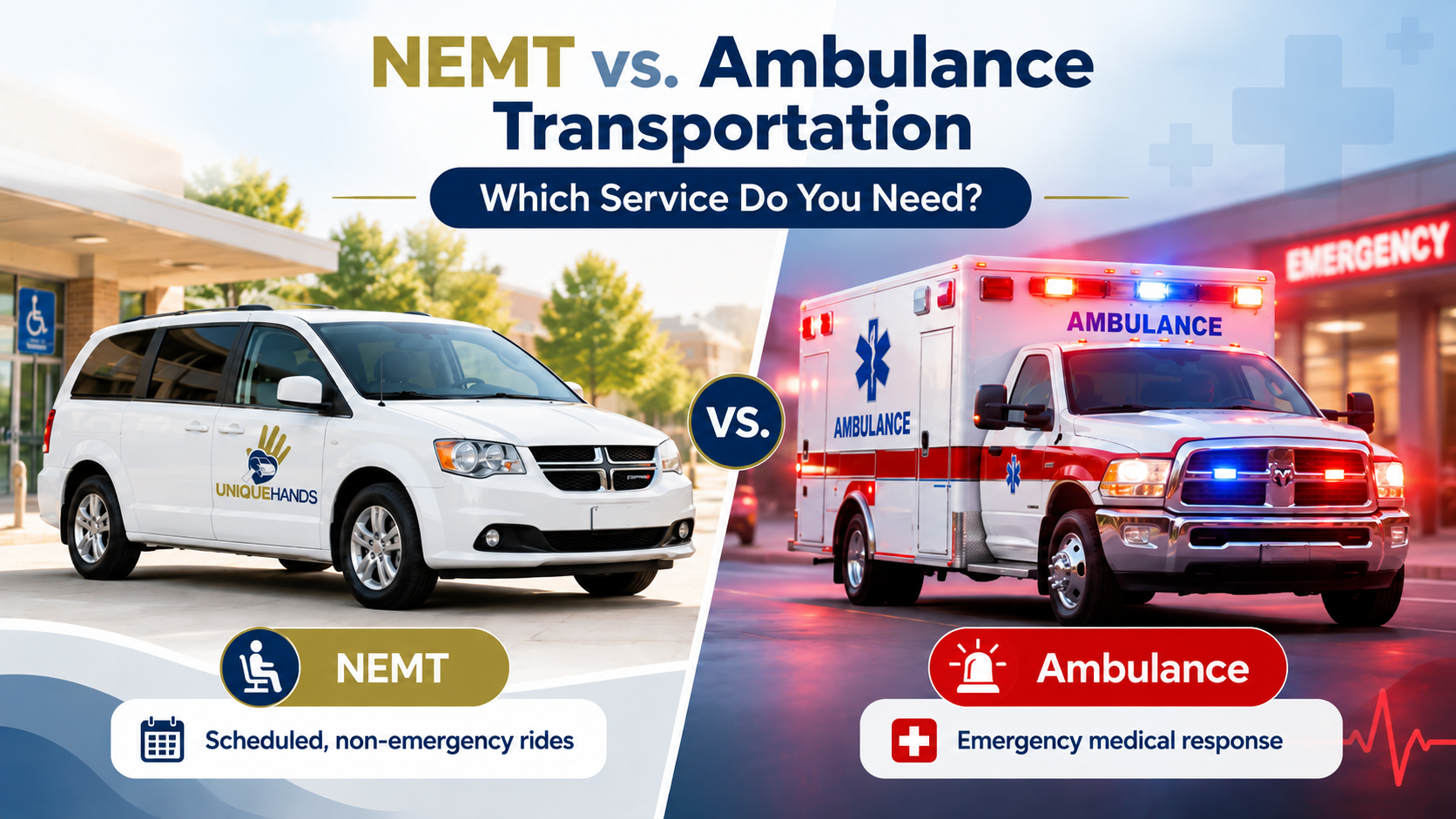
Non-Emergency Medical Transportation Is Not an Ambulance Service
Scheduled non-emergency medical transportation is designed for passengers who do not require emergency medical treatment or continuous clinical monitoring during their journey.
Mobility assistance and accessible transportation are different from critical-care transport, emergency medical services, or medical evacuation.
Important: UniqueHands does not operate as an emergency ambulance service and does not provide emergency medical treatment. For emergencies, call 911.
How to Arrange Long-Distance Transportation to or from New York
Thoughtful preparation helps clarify travel requirements before the transportation date.
Confirm Pickup and Destination
Provide complete addresses, proposed travel date, and appointment or arrival requirements.
Discuss Mobility Needs
Explain whether the passenger can walk, uses a wheelchair, requires a stretcher, or needs additional assistance.
Review Property Access
Mention stairs, elevators, narrow entryways, facility restrictions, and transfer requirements.
Plan for Travel Time
Consider traffic, distance, passenger comfort, arrival schedules, and appropriate travel breaks.
Coordinate the Destination
Confirm the receiving facility, entrance instructions, appointment timing, and contact details.
Review Transportation Details
Discuss scheduling, companion arrangements, requested assistance, and private-pay pricing.
Door-to-Door and Escort Assistance for Medical Travel
Some travelers need more than vehicle transportation. Assistance may be needed at the pickup location, during loading or unloading, or when transitioning to the destination.
UniqueHands provides assisted transportation arrangements and escort support by advance arrangement, subject to the passenger's needs and the transportation being requested.
New York buildings can vary significantly in accessibility. Apartment entrances, elevators, narrow corridors, busy streets, and restricted loading areas can affect transportation planning.
Discuss these details before scheduling, especially when the passenger requires wheelchair or stretcher access.
What Affects the Cost of New York Medical Transportation?
Long-distance medical transportation pricing depends on the route, total distance, transportation configuration, passenger mobility, and requested assistance.
Distance and Route
Travel between Northern Virginia and New York may involve different distances, highways, traffic, and tolls.
Passenger Mobility
Ambulatory, wheelchair, stretcher, and bed-to-bed transportation can involve different arrangements.
Requested Assistance
Transfers, escort arrangements, property accessibility, and destination requirements may affect the service.
Private-pay transportation: UniqueHands does not bill Medicare or Medicaid for rides. For pricing, share the requested route, travel date, passenger mobility, and assistance details.
Why Families Consider UniqueHands for Long-Distance Transportation
UniqueHands is a Northern Virginia private-pay medical transportation provider offering wheelchair, stretcher, ambulatory, assisted, bed-to-bed, senior, and long-distance transportation.
The company has more than a decade of experience helping passengers and families arrange non-emergency medical trips.
For longer journeys, attention to passenger mobility, proper transportation configuration, pickup access, timing, and destination instructions is important.
Our focus is on professional, respectful, pre-arranged transportation rather than emergency medical care.
Learn more about UniqueHands and our medical transportation services.
Making Long-Distance Medical Travel Between New York and Virginia More Manageable
Interstate medical transportation can be an important option for people with mobility limitations who need to reach a healthcare destination or return home after treatment.
Selecting suitable transportation, confirming passenger mobility, preparing for the route, and coordinating the destination can make longer journeys easier to organize.
For details about qualifying routes and scheduling, explore UniqueHands' long-distance medical transportation service.
New York Long-Distance Medical Transportation FAQs
Is UniqueHands based in New York?
No. UniqueHands is based in Northern Virginia and provides qualifying long-distance interstate transportation, including requests involving New York.
Can UniqueHands transport wheelchair passengers to or from New York?
Wheelchair-accessible transportation may be arranged for qualifying long-distance journeys. Routes and mobility requirements must be reviewed before booking.
Is stretcher transportation available for interstate trips?
UniqueHands provides non-emergency stretcher transportation. Availability for a New York route depends on the passenger's needs and scheduling.
Can a family member travel with the passenger?
Companion travel and escort arrangements should be discussed when scheduling so vehicle space and requested assistance can be reviewed.
Can I arrange transportation from a New York hospital?
Scheduled non-emergency transportation involving a hospital or rehabilitation facility may be possible for qualifying passengers and routes.
Does UniqueHands provide ambulance services?
No. UniqueHands is a pre-arranged non-emergency medical transportation provider and does not provide emergency ambulance or clinical treatment services.
How much does long-distance transportation to New York cost?
Costs depend on distance, transportation type, mobility needs, and any additional assistance. Contact UniqueHands with your trip details for a quote.
How early should an interstate trip be booked?
Advance scheduling is recommended because longer journeys require additional coordination and vehicle planning.
Planning Medical Transportation Between New York and Northern Virginia?
Whether arranging a wheelchair trip, stretcher transportation, a hospital-to-home journey, or another qualifying interstate medical trip, UniqueHands can discuss your transportation needs.
Private-pay, pre-arranged non-emergency ground transportation based in Northern Virginia.
Scheduled non-emergency transportation. No emergency ambulance or clinical services.
UNIQUEHANDS RESOURCES
Medical Transportation Articles
Explore practical guides for families, caregivers, and facilities planning wheelchair, stretcher, ambulatory, hospital discharge, long-distance, and state-to-state non-emergency medical transportation.