Ambulatory Transportation After a Procedure in Fairfax County: What Patients Should Know

Fairfax County Post-Procedure Transportation Guide

Walking After a Procedure Does Not Always Mean Driving Home Is Appropriate

A patient may be fully ambulatory and still need transportation after an outpatient procedure because of anesthesia, medication, weakness, discharge instructions or temporary driving restrictions.

This is where the term ambulatory transportation can become confusing. In medical transportation, ambulatory generally refers to a passenger who can walk and does not need to travel in a wheelchair or stretcher.

It does not mean the passenger is automatically safe to drive after every procedure.
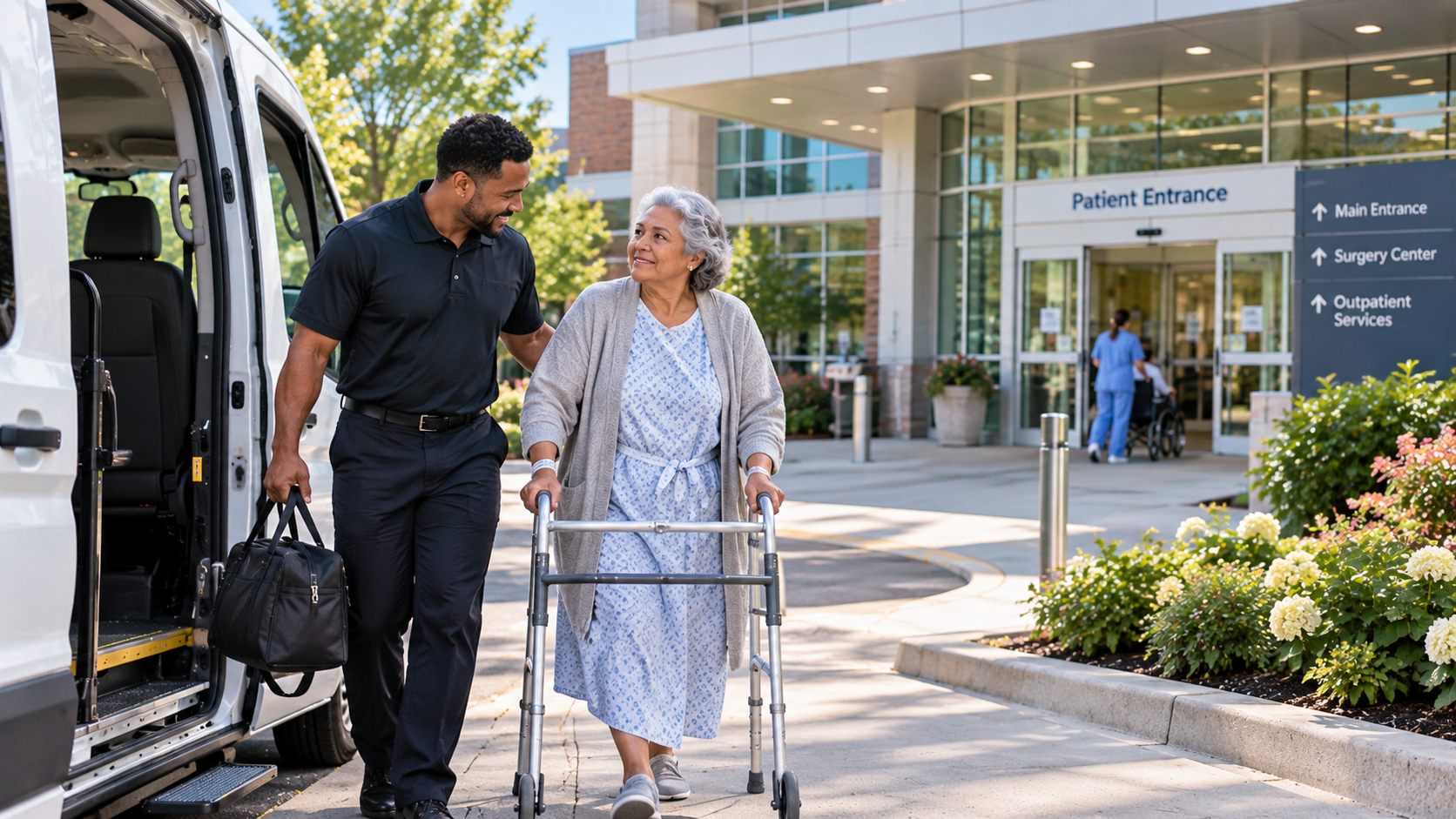
Ambulatory transportation after outpatient procedures for patients in Fairfax County Virginia
“Ambulatory” describes how the passenger moves — not whether a procedure allows the patient to drive home.
NEED AMBULATORY TRANSPORTATION?

Visit Our Main Ambulatory Transportation Service Page

This page explains how post-procedure transportation should be planned. For direct service information, visit our Ambulatory Transportation page.

For broader local transportation services in Fairfax, visit Non-Emergency Medical Transportation in Fairfax.

FIRST: UNDERSTAND THE TERM

What Is Ambulatory Transportation?

Ambulatory transportation is generally intended for passengers who can walk independently or with limited assistance and do not need to remain in a wheelchair or stretcher during the trip.

01

Passenger Can Walk

The passenger is able to walk to and from the transportation vehicle, either independently or with limited non-clinical assistance.

02

No Wheelchair Vehicle Required

The passenger does not need to remain seated in a wheelchair during transportation.

03

No Stretcher Positioning Required

The passenger can safely tolerate ordinary seated transportation and does not require non-emergency stretcher travel.

AFTER OUTPATIENT CARE

Why an Ambulatory Patient May Still Need a Ride Home

Many outpatient procedures do not permanently affect mobility. A patient may be able to walk out of the facility but still be under instructions not to drive.

Depending on the procedure, anesthesia, sedation, medication or the healthcare provider’s instructions may affect driving or independent travel for a period after discharge.

The healthcare facility — not the transportation company — determines when a patient is medically ready for discharge and what escort or responsible-adult requirements apply.

Examples of Procedures That May Require Transportation Planning

  • Outpatient surgery
  • Endoscopy
  • Colonoscopy
  • Procedures involving sedation
  • Dental or oral surgery
  • Eye procedures
  • Diagnostic procedures
  • Same-day surgical procedures
FAIRFAX COUNTY PROCEDURE LOCATIONS

Procedure Transportation Can Look Very Different Across Fairfax County

Fairfax-area patients may receive outpatient care at hospital campuses, ambulatory surgery centers, specialist offices or independent procedure locations. Knowing the exact facility before transportation day matters.

FAIR OAKS

Inova Fair Oaks Hospital Surgery Center

Inova Fair Oaks Hospital operates inpatient and outpatient same-day surgery services at 3600 Joseph Siewick Drive in Fairfax. The Fair Oaks campus also includes an ambulatory surgery center nearby. :contentReference[oaicite:1]{index=1}

Families should confirm whether the procedure is at the hospital itself or at a nearby surgery center before arranging pickup.

FALLS CHURCH / FAIRFAX MEDICAL CAMPUS

Inova Fairfax Medical Campus

Inova Fairfax Medical Campus at 3300 Gallows Road includes multiple surgery centers and outpatient procedural locations, including the Professional Services Building and other surgical departments. :contentReference[oaicite:2]{index=2}

For mobility-limited or recently sedated passengers, the exact building and entrance can matter as much as the street address.

ANNANDALE

Inova Woodburn Surgery Center

Inova lists its Woodburn Surgery Center at 3289 Woodburn Road in Annandale as part of the Fairfax Medical Campus surgery-center network. :contentReference[oaicite:3]{index=3}

Annandale residents and families should confirm the exact center rather than assuming every Inova procedure takes place on Gallows Road.

FAIRFAX COUNTY COMMUNITIES

Trips May Start Far From the Procedure Center

Patients may travel from Vienna, Herndon, Reston, Springfield, Centreville, Burke, McLean, Annandale or other Fairfax County communities to a completely different part of the county for care.

That makes departure time, traffic, return-trip planning and facility pickup instructions important.

LOCAL TRAVEL REALITY

A Fairfax County Procedure Trip Should Not Be Planned Around Mileage Alone

A patient in Centreville traveling toward Fair Oaks may have a very different trip from a Vienna resident traveling toward the Gallows Road medical campus.

Routes may involve I-66, Route 50, Route 29, Fairfax County Parkway, Route 123, Gallows Road or other busy Fairfax corridors.

Procedure-day timing should account for traffic plus the time required for facility check-in, discharge, walking from the procedure area and the designated pickup point.

Allow Time For:

  • Morning and afternoon traffic
  • Medical-campus navigation
  • Parking and passenger pickup areas
  • Facility check-in
  • Procedure delays
  • Recovery and discharge
  • Return travel
IMPORTANT BEFORE BOOKING

A Transportation Reservation Does Not Automatically Satisfy a Facility’s Escort Rule

This is one of the most important things patients should understand before arranging transportation after a procedure.

Some facilities require a responsible adult to remain with the patient after sedation or to accompany the patient at discharge.

A transportation driver may not automatically satisfy that requirement. Patients should confirm the facility’s policy before scheduling transportation.

Ask the Procedure Center:

  • May I leave with a transportation provider?
  • Must a responsible adult accompany me?
  • Must that person remain at the facility?
  • Can the facility call transportation when I am ready?
  • What entrance is used for discharge?
  • How long should someone remain with me afterward?
CHOOSING THE RIGHT TYPE OF RIDE

Family Ride, Taxi, Rideshare or Ambulatory NEMT?

There is no single transportation option that is best after every outpatient procedure.

F

Family or Friend

Often the simplest option when a trusted adult is available and the arrangement satisfies the facility’s discharge requirements.

R

Taxi or Rideshare

May be appropriate for some passengers, but a facility may not allow an unaccompanied sedated patient to leave with an ordinary rideshare or taxi driver.

N

Ambulatory NEMT

May be useful when a walking passenger needs scheduled private-pay transportation connected to a healthcare appointment, procedure or discharge.

MOBILITY CAN CHANGE AFTER A PROCEDURE

What If the Passenger Is No Longer Fully Ambulatory?

Sometimes a passenger expects to walk after a procedure but mobility is more limited than anticipated.

If the passenger cannot safely walk to and from the vehicle, requires a wheelchair, cannot remain seated or has significant transfer limitations, ambulatory transportation may no longer be the right option.

The transportation type should match the passenger’s actual condition at discharge.

Another Service May Be Needed If:

  • The passenger now needs a wheelchair
  • The passenger cannot walk safely
  • The passenger cannot transfer into a standard seat
  • The passenger cannot remain seated
  • Bedside assistance is required
  • Access conditions make ordinary pickup impractical
HAVE THIS INFORMATION READY

Post-Procedure Transportation Checklist

Procedure Facility Provide the exact hospital, surgery center or medical-office name.
Building or Entrance Large campuses may have separate outpatient and discharge locations.
Procedure Time Include the required check-in time, not just the procedure time.
Expected Discharge Window Procedure end times are not always exact.
Mobility After the Procedure Confirm whether the patient is expected to remain ambulatory.
Escort Requirement Confirm whether the facility requires a responsible adult.
Home Access Mention stairs, elevators or long walks from vehicle access.
Return-Trip Contact Determine who should call when the passenger is ready for pickup.
FAIRFAX TRANSPORTATION RESOURCES

Continue Through Our Fairfax Transportation Guides

For ambulatory transportation service information, visit Ambulatory Transportation.

For direct Fairfax local NEMT information, visit our main Fairfax NEMT page.

For broader transportation-planning information, see Medical Transportation in Fairfax, Virginia.

POST-PROCEDURE TRANSPORTATION FAQ

Common Questions From Fairfax County Patients

What does ambulatory transportation mean?

Ambulatory transportation generally refers to scheduled transportation for passengers who can walk and do not need to remain in a wheelchair or stretcher during the trip.

Can I use ambulatory transportation after outpatient surgery?

It may be appropriate if the healthcare facility clears the passenger for non-emergency transportation, the passenger can safely walk, and the transportation arrangement satisfies the facility’s discharge requirements.

Does a transportation driver count as my required responsible adult?

Not necessarily. Procedure centers set their own discharge and escort rules. Confirm directly with the facility before transportation is scheduled.

Can I take Uber or Lyft home after sedation?

That depends on the facility’s discharge policy. Some facilities may not release a sedated patient to an unaccompanied rideshare driver.

What if I need a wheelchair after the procedure?

If the passenger cannot safely walk to and from the vehicle, wheelchair transportation may be more appropriate than ambulatory transportation.

Where is UniqueHands' main ambulatory transportation page?

Visit Ambulatory Transportation for service-specific information and transportation requests.

Is post-procedure ambulatory transportation emergency medical care?

No. UniqueHands provides scheduled non-emergency transportation and does not replace emergency ambulance care, clinical treatment or medical monitoring. Call 911 for a medical emergency.

FAIRFAX COUNTY AMBULATORY TRANSPORTATION

Have an Upcoming Procedure and Need a Ride?

Confirm your facility’s discharge requirements first. Then have the procedure location, expected discharge window, home destination, mobility information and escort requirements ready when requesting transportation.

Important: UniqueHands provides scheduled private-pay non-emergency medical transportation. Transportation staff do not provide clinical treatment, emergency medical response or continuous medical monitoring. Follow the discharge instructions provided by the procedure facility. For an emergency, call 911.

SHARE THIS RESOURCE

Know Someone Who May Find This Helpful?

Share this UniqueHands medical transportation resource with a family member, caregiver, healthcare professional, discharge planner, or facility coordinator.

UNIQUEHANDS RESOURCES

Medical Transportation Articles

Explore practical guides for families, caregivers, and facilities planning wheelchair, stretcher, ambulatory, hospital discharge, long-distance, and state-to-state non-emergency medical transportation.


Wheelchair stretcher and ambulatory medical transportation options for Manassas Virginia residents
September 10, 2026
Compare wheelchair, stretcher and ambulatory transportation in Manassas, VA and learn which option may fit appointments, discharge, therapy and medical trips.
Comparing non-emergency medical transportation companies for patients and families in Manassas VA
September 10, 2026
Compare NEMT companies in Manassas, VA by transportation type, wheelchair or stretcher needs, hospital access, pricing, scheduling, trip scope and service limits.
Non-emergency medical transportation for patients and families in Manassas Virginia
September 10, 2026
Learn how NEMT can help Manassas residents with wheelchair access, hospital discharge, medical appointments, rehabilitation, caregiver needs and longer trips.
Choosing a non-emergency medical transportation provider in Fairfax County for wheelchair, stretcher
September 10, 2026
Learn how to compare NEMT providers in Fairfax County for wheelchair, stretcher, senior, hospital and appointment trips, including pricing and scheduling.
Choosing a non-emergency medical transportation provider for patients and families in Fairfax Virgin
September 10, 2026
Learn what to ask before choosing a NEMT provider in Fairfax, VA, including mobility needs, vehicles, stairs, scheduling, pricing, return trips and service limits.
Non-emergency medical transportation in Fairfax County for seniors, wheelchair users and stretcher
September 9, 2026
Learn when non-emergency medical transportation may be appropriate in Fairfax County for seniors, wheelchair users, procedures, discharges and recurring care.
View More Articles