Independent Everyday Travel
Seniors who can board and exit ordinary public transportation may be able to use Fairfax Connector, CUE, Metrobus or Metrorail.
Fairfax County older adults may use public transit, paratransit, subsidized transportation programs, taxis, volunteer driver programs or private-pay transportation depending on eligibility and mobility.
Families should understand the differences before a medical appointment, hospital discharge or change in mobility creates an urgent need.

Transportation to a grocery store, senior center or social activity can often be handled differently from a trip involving a wheelchair, hospital discharge, rehabilitation appointment or passenger who cannot transfer into a standard vehicle.
Seniors who can board and exit ordinary public transportation may be able to use Fairfax Connector, CUE, Metrobus or Metrorail.
Older adults who cannot independently use fixed-route transit may need to explore paratransit, specialized human-services transportation or accessible taxi options.
Seniors with wheelchair, stretcher, transfer or hospital-discharge needs may require a transportation option designed around the passenger’s mobility.
Fairfax Connector is one of the county’s primary public transit systems. Fairfax County also points older adults toward Metrobus, Metrorail, Virginia Railway Express and the City of Fairfax CUE system when those services fit the trip. :contentReference[oaicite:1]{index=1}
Public transit may be useful for shopping, social activities, routine appointments and other destinations when the passenger can independently manage stops, boarding, transfers and the distance between the stop and the final destination.
Fairfax County lists several specialized transportation resources for older adults and people with disabilities, including MetroAccess and Fastran. :contentReference[oaicite:2]{index=2}
MetroAccess is a regional paratransit option for eligible individuals whose disability prevents them from independently using accessible fixed-route Metrobus or Metrorail service.
Eligibility and trip rules apply, so families should review the current program requirements before relying on MetroAccess for a specific appointment.
Fairfax County describes Fastran as specialized transportation for certain residents participating in county human-services programs. Destinations can include critical medical care and other approved human-services locations. :contentReference[oaicite:3]{index=3}
Fastran is not simply an on-demand replacement for private medical transportation; program eligibility and destination rules matter.
Fairfax County’s Transportation Options, Programs and Services program — TOPS — provides subsidized transportation funds for eligible older adults, people with disabilities and residents with limited income. Eligible residents may use approved transportation options through the program. :contentReference[oaicite:4]{index=4}
One important current detail: Fairfax County states that the TOPS waitlist closed in August 2025 because of application volume, although other related programs such as TRIP remain available subject to their own eligibility requirements. :contentReference[oaicite:5]{index=5}
Fairfax County currently lists TRIP as a discounted Fairfax Connector program for eligible riders. :contentReference[oaicite:6]{index=6}
Fairfax County licenses several taxicab companies and also operates subsidy programs for certain eligible residents. The county currently lists Fairfax Red Top Cab, Fairfax Yellow Cab and Springfield Yellow Cab among licensed providers. :contentReference[oaicite:7]{index=7}
Fairfax County advises passengers who cannot transfer from a wheelchair to request an accessible taxi in advance. :contentReference[oaicite:8]{index=8}
An accessible taxi may work well for some wheelchair users, but it is different from stretcher or bed-to-bed medical transportation.
Fairfax County also directs older residents to volunteer driving programs and NV Rides, a network that supports nonprofit organizations providing free or low-cost transportation to older adults. :contentReference[oaicite:9]{index=9}
Some volunteer programs focus on rides to healthcare appointments for older adults who can use an ordinary passenger vehicle.
Volunteer programs may help reduce isolation by making it easier for seniors to reach community activities or routine destinations.
Volunteer transportation is not the same as wheelchair, stretcher or bed-to-bed NEMT, so the passenger’s mobility still determines whether it is appropriate.
Public transit, taxis and volunteer programs are valuable, but they do not solve every mobility problem.
A senior who uses a wheelchair, cannot safely transfer into a standard vehicle, cannot remain seated, is being discharged from a hospital, or needs transportation beginning at the bedside may require a different level of transportation planning.
This is where private-pay non-emergency medical transportation can become useful.
Many Fairfax seniors want to remain in their homes as long as possible. Transportation can become one of the first practical challenges.
A senior may still live independently even after no longer feeling comfortable driving on Route 50, Route 29, I-66 or other busy Fairfax corridors.
Adult children may work during appointment hours or live elsewhere in Northern Virginia, making transportation planning more important.
The same senior who once used a taxi independently may later require a wheelchair-accessible or medically appropriate transportation option.
Fairfax County lists public transit, MetroAccess, Fastran, TOPS/TRIP, taxi options, volunteer driving programs and other mobility resources for older adults and people with disabilities. Eligibility varies by program. :contentReference[oaicite:10]{index=10}
Yes. Fairfax County operates subsidy programs such as TOPS and TRIP for eligible residents. Current eligibility, availability and application status should be checked with the county. :contentReference[oaicite:11]{index=11}
Accessible taxi service may be available. Fairfax County advises wheelchair users who cannot transfer to request an accessible taxi in advance. :contentReference[oaicite:12]{index=12}
If the passenger cannot safely transfer into a standard vehicle, wheelchair-accessible or another specialized transportation option may need to be considered.
Wheelchair transportation may not be appropriate when the passenger cannot safely tolerate an upright seated position. Stretcher transportation may need to be considered.
Visit Non-Emergency Medical Transportation in Fairfax for UniqueHands local service information and transportation requests.
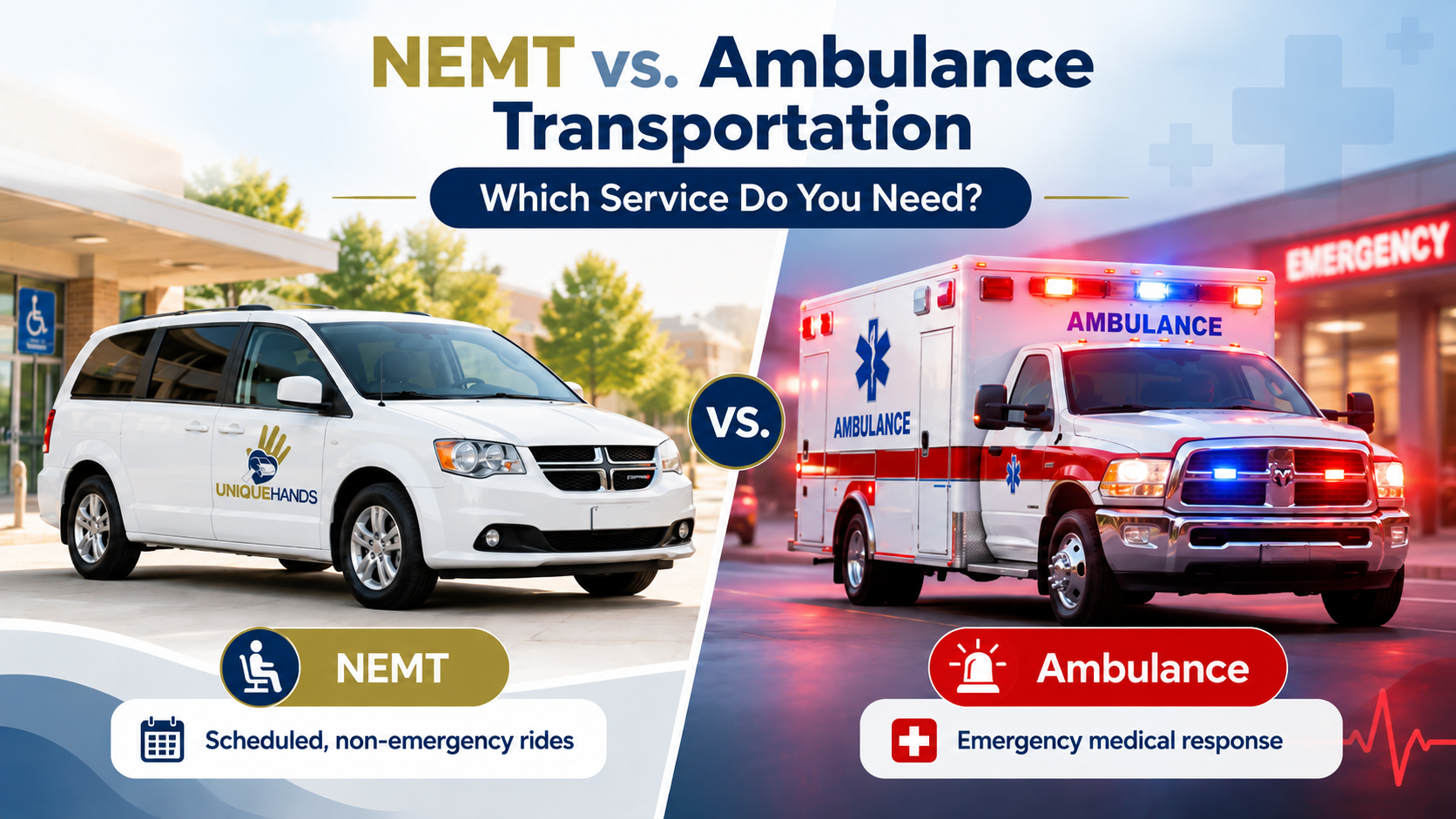
No. Non-emergency medical transportation is scheduled transportation and does not replace emergency ambulance care. Call 911 for a medical emergency.
If the passenger uses a wheelchair, cannot safely transfer, needs stretcher transportation, is being discharged from a hospital or has other significant mobility needs, review the trip before choosing the transportation option.
UNIQUEHANDS RESOURCES
Explore practical guides for families, caregivers, and facilities planning wheelchair, stretcher, ambulatory, hospital discharge, long-distance, and state-to-state non-emergency medical transportation.