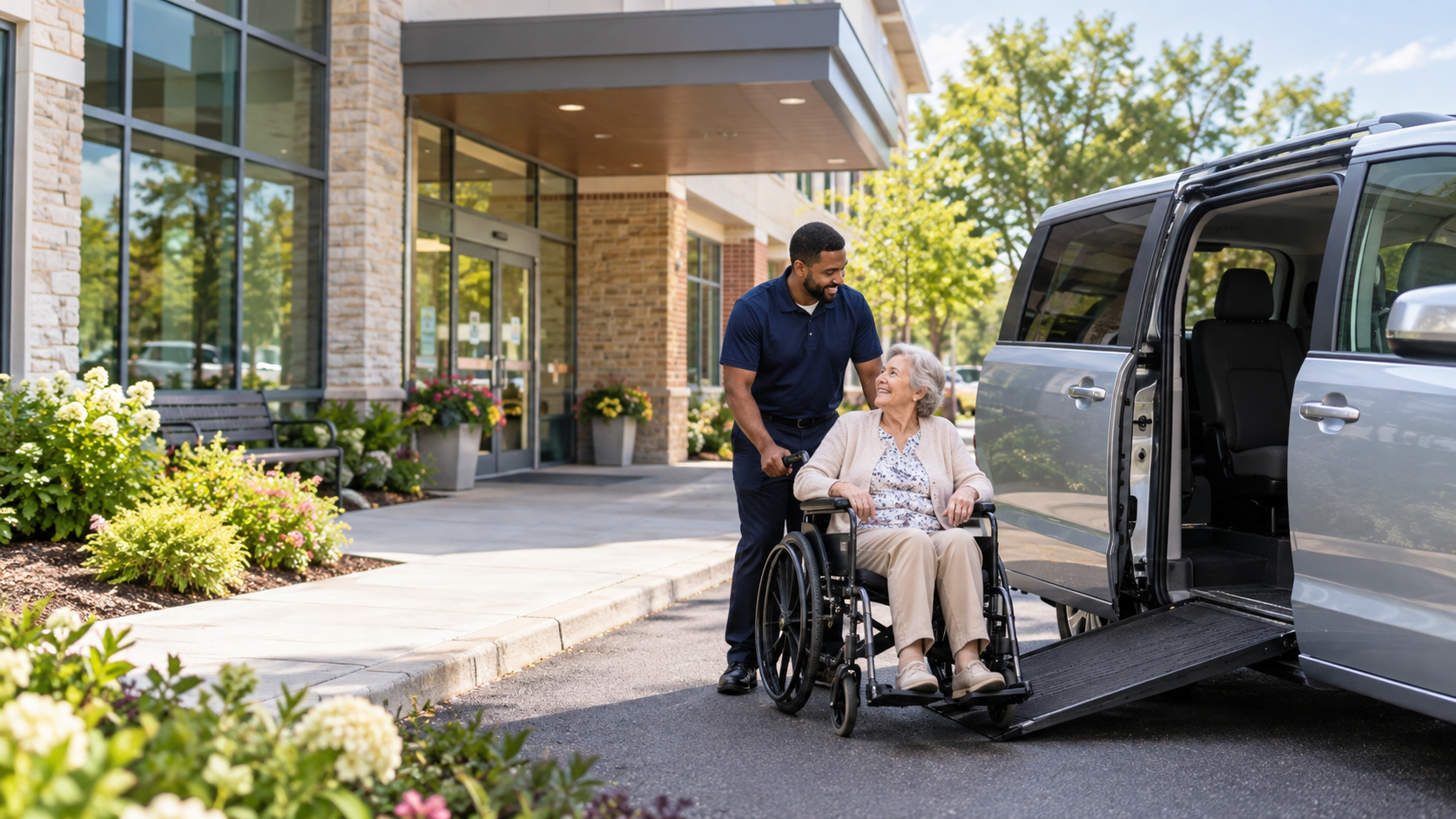
Wheelchair Users
A passenger may need an accessible transportation vehicle because transferring into a standard car is difficult or inappropriate.
Non-emergency patient transportation is used when a passenger does not require emergency ambulance response but cannot appropriately use an ordinary transportation option for the requested trip.
The correct transportation arrangement depends on mobility, ability to transfer, whether the passenger can remain seated, wheelchair or stretcher needs, pickup access and the destination.

Families do not always use industry terminology. Someone may search “patient transport service” after a hospital discharge while another family searches “wheelchair ride to doctor” for a very similar type of transportation need.
Patient transportation is a broad phrase describing transportation of a person connected with healthcare or mobility needs.
Non-emergency medical transportation (NEMT) generally describes scheduled transportation for passengers who do not require emergency ambulance response.
Wheelchair, stretcher, ambulatory and bed-to-bed transportation describe more specific transportation arrangements based primarily on passenger mobility and trip needs.
A passenger may need an accessible transportation vehicle because transferring into a standard car is difficult or inappropriate.
Illness, surgery or hospitalization can temporarily change how a passenger walks, transfers or tolerates sitting.
An older Fairfax resident may no longer drive or may have difficulty entering a family vehicle even though emergency transportation is not needed.
A passenger who cannot safely transfer or remain seated may require transportation planning beyond a standard wheelchair trip.
Repeated physical therapy or rehabilitation visits can create an ongoing transportation need when driving or ordinary transportation is impractical.
Specialty treatment outside Fairfax may require more planning around travel time, positioning and the receiving location.
Fairfax residents may be traveling across the city, toward Fair Oaks, to the Inova Fairfax Medical Campus, to rehabilitation, or beyond Fairfax for specialty care.
Trips toward Inova Fair Oaks Hospital and nearby medical offices may involve hospital discharge, imaging, physician appointments, gastroenterology, rehabilitation or other scheduled care.
The Inova Fairfax Medical Campus contains multiple hospitals, institutes and entrances. Families should confirm the exact building and receiving location rather than providing only “Inova Fairfax.”
Passenger boarding, traffic, facility entrances and appointment check-in can turn a short local trip into a longer transportation window.
Regional medical trips may extend toward other parts of Northern Virginia, making travel time and return transportation more important.
The medical appointment itself does not determine the transportation type. Mobility and positioning usually matter more.
For passengers who can walk independently or with limited assistance but need scheduled transportation for healthcare-related travel.
For passengers who use a wheelchair and need an accessible transportation vehicle rather than an ordinary passenger car.
May be appropriate when a passenger cannot safely or comfortably remain seated during a scheduled non-emergency trip.
May involve additional planning when transportation begins before the passenger reaches the vehicle because of substantial mobility limitations.
Hospital discharge is one of the situations where families suddenly discover that an ordinary car may not work.
A passenger may be medically ready to leave the hospital but still have weakness, wheelchair use, difficulty transferring, positioning limitations or access needs at the destination.
Transportation should be matched to the passenger’s current mobility — not simply how they traveled before hospitalization.
Non-emergency patient transportation can also be used for routine scheduled healthcare travel when the passenger cannot appropriately use an ordinary transportation option.
This can include physician visits, rehabilitation, imaging, outpatient procedures, specialist care and follow-up appointments.
The transportation provider should be given the required arrival time, exact medical destination and whether a return trip will be needed.
Non-emergency transportation is for scheduled trips when emergency intervention is not required.
It does not replace emergency response, clinical treatment, emergency medical monitoring or ambulance-level care.
If a person is experiencing a medical emergency or needs immediate emergency intervention, call 911.
UniqueHands provides private-pay non-emergency medical transportation. The cost of a trip can vary because not every passenger requires the same vehicle or transportation arrangement.
Distance matters, but so can wheelchair or stretcher requirements, access conditions, trip timing, destination and return-trip needs.
Families should provide complete trip information when requesting transportation rather than comparing services based only on mileage.
It is scheduled transportation for passengers who do not require emergency ambulance response but may need transportation related to healthcare, mobility or access needs.
The terms are often used loosely. “Patient transport” is a broad phrase, while non-emergency medical transportation more specifically describes scheduled non-emergency transportation for qualifying trips.
Depending on mobility needs, transportation may include ambulatory, wheelchair, stretcher, bed-to-bed or long-distance transportation.
Scheduled non-emergency transportation may be appropriate after a passenger has been medically cleared for discharge but cannot appropriately use ordinary transportation.
Wheelchair transportation may not be appropriate when a passenger cannot safely tolerate an upright seated position. Stretcher transportation may need to be considered.
Visit Non-Emergency Medical Transportation in Fairfax for local service information and transportation requests.
No. NEMT does not replace emergency ambulance care. Call 911 for a medical emergency or when immediate emergency intervention is needed.
Have the passenger’s mobility, pickup address, destination, requested date and time, wheelchair or stretcher need, stairs or elevators and return-trip information ready.
UNIQUEHANDS RESOURCES
Explore practical guides for families, caregivers, and facilities planning wheelchair, stretcher, ambulatory, hospital discharge, long-distance, and state-to-state non-emergency medical transportation.





UniqueHands
Non-Emergency Medical Transportation
Serving Northern Virginia
Contact our team to discuss the passenger’s mobility needs, pickup location, destination, and preferred travel date.
11166 Fairfax Blvd
Fairfax, VA 22030
Time-sensitive transportation request?
Text: (571) 419-3660
Advance reservations are recommended. After-hours transportation may be available by prior arrangement.
© 2026 All Rights Reserved by UniqueHands Non-Emergency Medical Transportation