Medical Transport Across States Without the Stress
Medical Transport Across States Without the Stress
Traveling across state lines for medical care can feel complicated, especially when the passenger uses a wheelchair, requires stretcher transportation, is being discharged from a hospital, or needs help planning a long journey. The trip becomes much easier when transportation is organized around the passenger’s mobility, pickup, destination, schedule, access requirements, and comfort before travel begins.
How do you arrange medical transportation across states?
Start by identifying the passenger’s transportation type, exact pickup and destination, travel date, mobility needs, hospital or facility schedule, access conditions, companion requirements, and any equipment that must travel with the passenger. A long-distance medical transportation provider can then determine the appropriate vehicle, trip schedule, and transportation plan.
Why Can Medical Transport Across States Feel Complicated?
Long-distance medical transportation involves more planning than an ordinary local ride. The passenger may be traveling several hours, crossing multiple state lines, leaving a hospital or rehabilitation facility, relocating to another care setting, or traveling to receive specialized medical treatment.
Families may also be trying to coordinate doctors, discharge personnel, caregivers, destination facilities, luggage, medications, mobility equipment, and travel timing at the same time.
Who May Need State-to-State Medical Transportation?
Interstate non-emergency medical transportation can support many different travel situations when the passenger is appropriate for pre-arranged ground transportation.
What Type of Transportation Does the Passenger Need?
One of the first questions to answer is how the passenger will safely and comfortably travel.
Appropriate for passengers who can walk or transfer with limited assistance but need pre-arranged transportation for a medical-related trip.
Learn about ambulatory transportation →Wheelchair transportation may be appropriate when the passenger needs an accessible vehicle and secure wheelchair transportation for the journey.
Explore wheelchair transportation →Some medically stable passengers cannot comfortably remain seated for a long trip and may require non-emergency stretcher transportation.
Learn about stretcher transportation →What Information Should You Have Before Calling?
Having the following information ready can make the scheduling process much easier:
- Passenger name and contact information
- Exact pickup address
- Exact destination address
- Requested travel date
- Appointment, admission, or discharge time
- Whether the passenger is ambulatory, wheelchair, or stretcher
- Wheelchair dimensions or special mobility equipment when relevant
- Stairs, elevators, ramps, narrow entrances, or other access conditions
- Whether a family member or caregiver will travel
- Expected luggage and personal belongings
- Whether the trip is one-way or round-trip
- Facility contact information when coordination is necessary
How Do You Plan an Interstate Trip After Hospital Discharge?
Hospital discharge transportation often requires additional coordination because the actual discharge time may depend on medical clearance, paperwork, medications, family communication, and facility procedures.
When the destination is in another state, it is especially important to confirm who will receive the passenger at the destination and whether the residence or facility is prepared for the passenger’s arrival.
Families should share the expected discharge window with the transportation provider and update the provider when the hospital changes the timing.
Why Do Pickup and Destination Access Matter?
A transportation plan should account for more than mileage. Stairs, elevators, narrow hallways, gated communities, difficult parking areas, facility entrances, and wheelchair accessibility can affect how a passenger is picked up and received.
Tell the transportation provider about these conditions before the trip rather than waiting until the vehicle arrives.
Can a Family Member or Caregiver Travel With the Passenger?
Depending on the trip, transportation type, available seating, vehicle capacity, and advance arrangements, a family member or caregiver may be able to travel with the passenger.
If a companion will travel, tell the transportation provider during scheduling so the vehicle arrangement can account for everyone who needs to make the trip.
How Can Families Make a Long Medical Trip More Comfortable?
Comfort matters more as travel time increases. Families should discuss the expected length of the trip, the passenger’s positioning needs, mobility equipment, belongings, destination arrangements, and any practical travel considerations before departure.
Older adults and passengers with limited mobility may especially benefit from having the entire journey planned before leaving the pickup location. For more information, read our guide to transporting elderly passengers long distance.
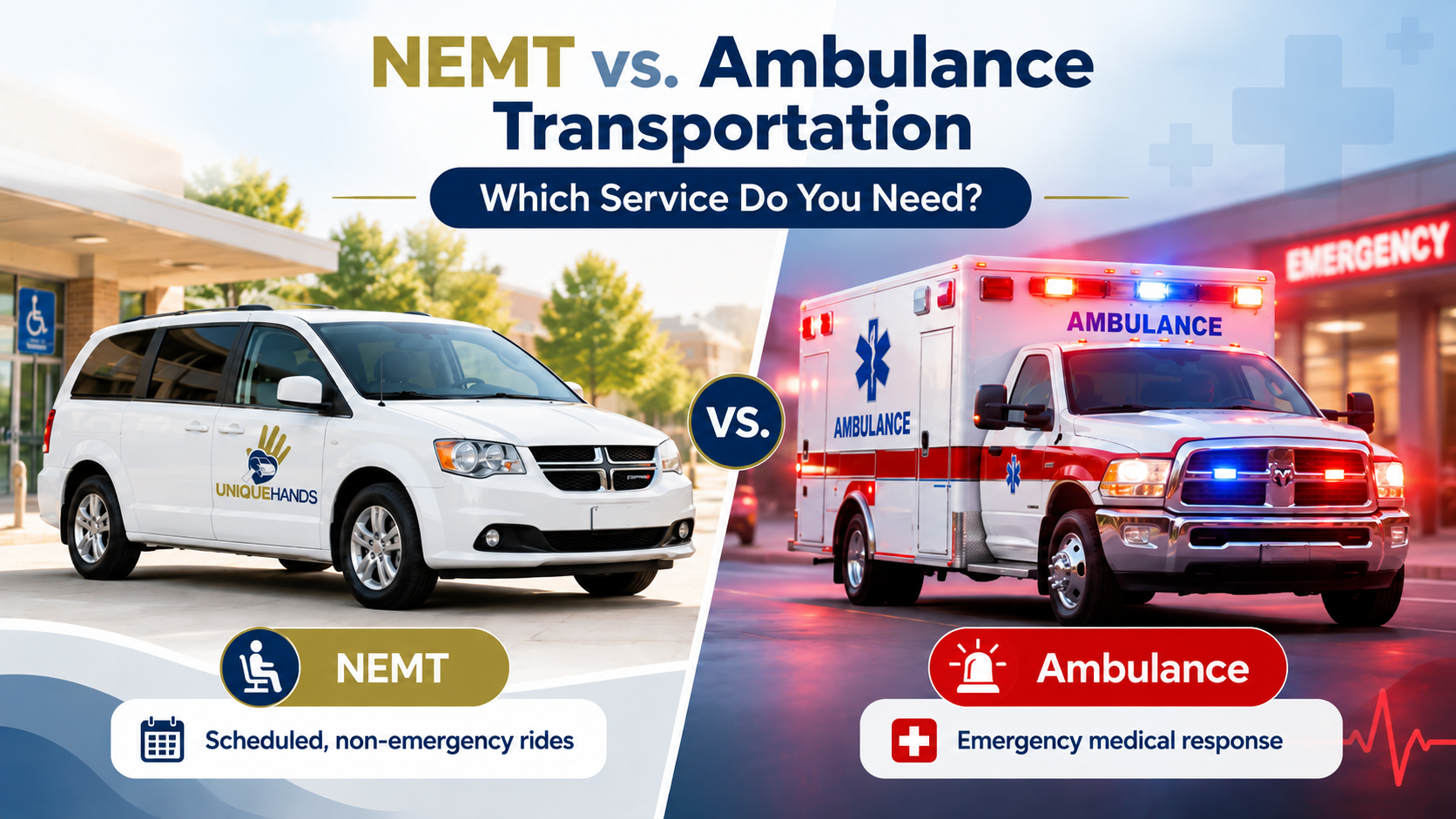
Is State-to-State NEMT the Same as an Ambulance?
No. Non-emergency medical transportation is intended for passengers who are appropriate for scheduled ground transportation and do not require emergency ambulance-level treatment or continuous emergency medical intervention during the trip.
If a person is experiencing a life-threatening emergency, severe breathing difficulty, loss of consciousness, uncontrolled bleeding, or another condition requiring immediate emergency care, call 911.
What Affects the Cost of Medical Transportation Across States?
Long-distance transportation pricing can vary because every trip is different. Mileage is important, but it is not the only factor.
Pricing may also be affected by transportation type, wheelchair or stretcher needs, trip duration, access conditions, waiting requirements, additional personnel, tolls, parking, companions, additional stops, and other trip-specific requirements.
UniqueHands provides private-pay transportation. A detailed trip request allows the team to review the transportation requirements before providing pricing.
How Far in Advance Should You Arrange an Interstate Medical Trip?
The earlier the trip is discussed, the more time there is to review the passenger’s mobility, vehicle requirements, travel schedule, pickup and destination access, and companion arrangements.
Advance planning is especially important for stretcher transportation, long interstate routes, hospital discharges, elderly passengers, and trips that require a caregiver or companion to travel.
Let UniqueHands Review Your Long-Distance Transportation Needs
Tell us the pickup location, destination, travel date, passenger mobility, wheelchair or stretcher needs, facility information, access conditions, and whether a companion will travel.
Medical Transport Across States: Common Questions
Can medical transportation cross state lines?
Yes. Long-distance non-emergency medical transportation can be arranged across state lines when the trip and passenger are appropriate for the transportation provider’s services.
Can a wheelchair passenger travel to another state?
Yes, when the passenger is appropriate for wheelchair-accessible non-emergency transportation and the trip can be safely planned with the necessary vehicle and access arrangements.
Can stretcher transportation be arranged across states?
Non-emergency stretcher transportation may be available for medically stable passengers who require stretcher positioning during a long-distance trip. The passenger’s needs should be discussed before scheduling.
Does UniqueHands provide interstate hospital discharge transportation?
UniqueHands can review qualifying long-distance and state-to-state hospital discharge transportation requests. The trip must be arranged in advance and depends on passenger needs, destination, timing, and availability.
Is long-distance medical transportation private pay?
UniqueHands provides private-pay transportation. Passengers or responsible parties should discuss trip details and pricing directly with UniqueHands before scheduling.
What happens if a passenger needs emergency medical care?
Non-emergency medical transportation does not replace emergency ambulance care. If a passenger experiences a life-threatening emergency or requires immediate emergency medical intervention, call 911.
Learn More About Long-Distance and State-to-State Transportation
UNIQUEHANDS RESOURCES
Medical Transportation Articles
Explore practical guides for families, caregivers, and facilities planning wheelchair, stretcher, ambulatory, hospital discharge, long-distance, and state-to-state non-emergency medical transportation.