Medical Transportation From State to State: What Families Need to Know
Traveling across state lines can be difficult when a passenger uses a wheelchair, cannot remain seated in a standard vehicle, is recovering from a procedure, or needs additional mobility support through pickup and arrival.
State-to-state medical transportation provides a scheduled ground transportation option for medically stable passengers who need more support than a taxi, rideshare, bus, train, or ordinary passenger vehicle can provide.
What Is State-to-State Medical Transportation?
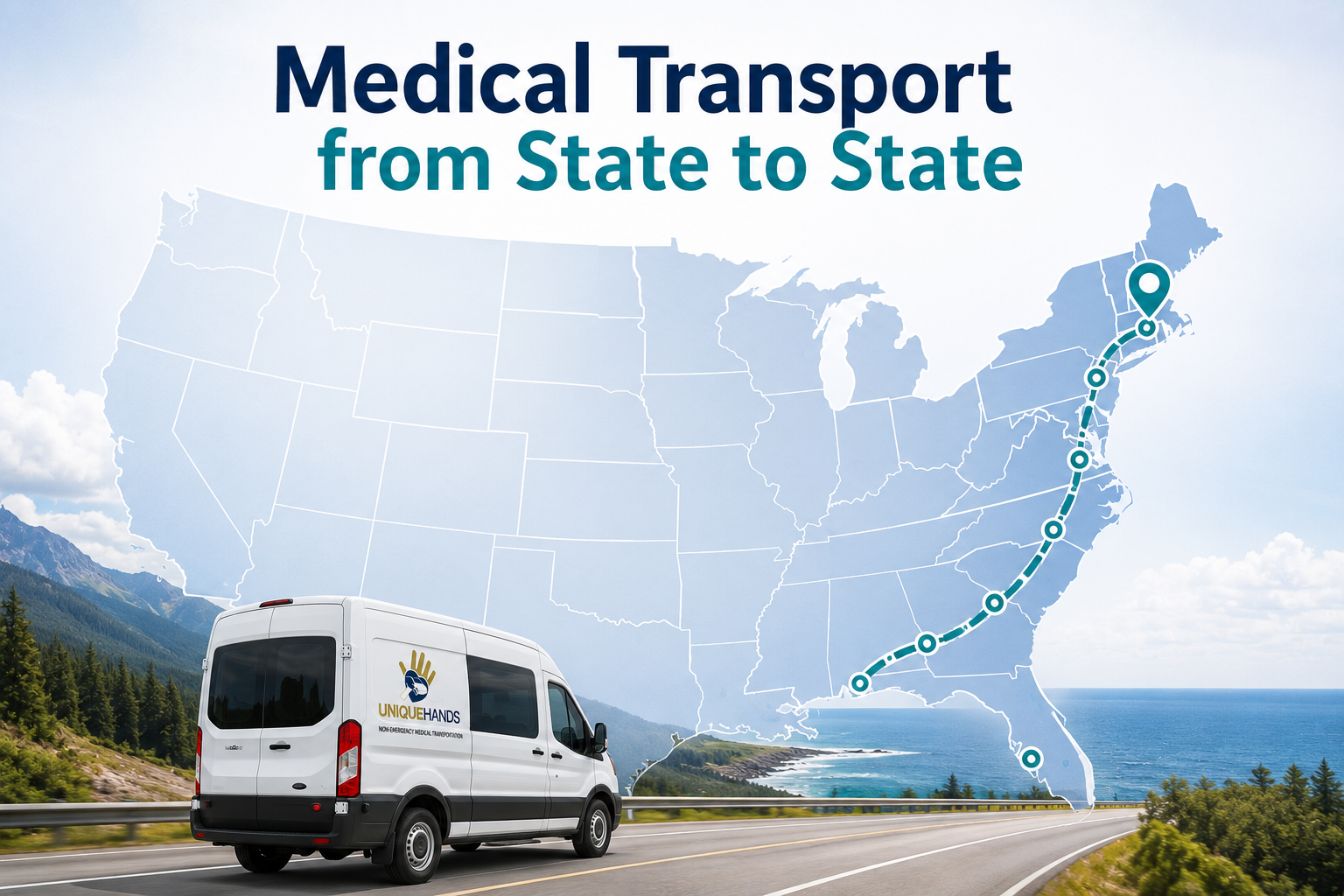
State-to-state medical transportation is prearranged, non-emergency ground transportation between locations in different states. It may be appropriate for medically stable ambulatory, wheelchair, or stretcher passengers traveling for a hospital discharge, facility admission, relocation, specialized appointment, rehabilitation stay, or move closer to family.
For complete information about scheduling longer private-pay trips, visit our main Long-Distance Medical Transportation service page.
When Families Use State-to-State Transportation
A family may need interstate transportation when a loved one cannot travel comfortably or safely in a standard passenger vehicle. The reason for travel is not always a medical appointment. Some trips involve discharge from a hospital, transfer to rehabilitation, assisted living, skilled nursing, or relocation to a family residence in another state.
Other passengers need state-to-state transportation because wheelchair use, positioning requirements, limited mobility, or an inability to remain seated makes ordinary travel difficult.
- Hospital discharge to an out-of-state residence
- Admission to a rehabilitation or senior care facility
- Relocation closer to children or other relatives
- Travel to a specialized medical appointment
- Return home after treatment in another state
- Transportation for a passenger with limited mobility
- Wheelchair-accessible interstate transportation
- Stretcher transportation for an eligible passenger
State-to-state transportation is one part of the broader Non-Emergency Medical Transportation Services available through UniqueHands.
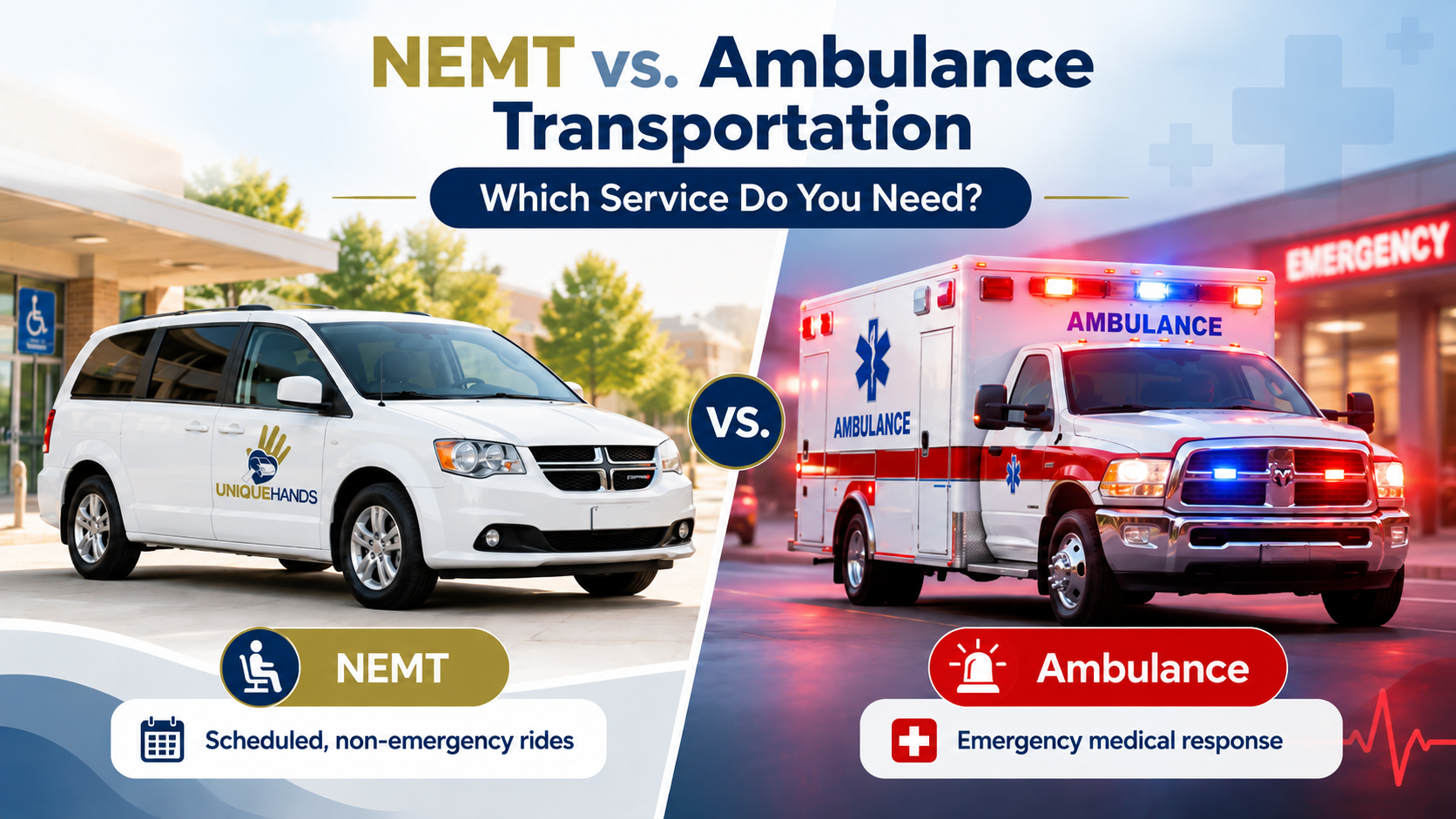
UniqueHands provides scheduled non-emergency transportation only. Anyone experiencing a medical emergency or requiring emergency medical treatment or ambulance-level care during travel should use the appropriate emergency service. For a medical emergency, call 911.
TRANSPORTATION OPTIONS
Choosing the Appropriate Type of Transportation
The transportation arrangement depends on the passenger's ability to walk, transfer, remain seated, use a wheelchair, tolerate a longer ground journey, and manage pickup and destination access.
Ambulatory Transportation
For passengers who can walk independently or with limited assistance but need scheduled transportation for a longer trip.
Explore Ambulatory TransportationWheelchair Transportation
For passengers who use a manual or power wheelchair and need accessible transportation rather than an ordinary passenger vehicle.
Explore Wheelchair TransportationStretcher Transportation
For medically stable passengers who cannot safely or comfortably remain seated for the duration of the requested ground trip.
Explore Stretcher TransportationBed-to-Bed Transportation
For passengers with significant mobility limitations who may need additional transportation coordination between the pickup location, vehicle, and receiving destination.
Explore Bed-to-Bed TransportationHOW IT WORKS
Planning a State-to-State Medical Transportation Trip
Interstate transportation requires more planning than a routine local ride because the route, trip duration, passenger mobility, access conditions, sending location, receiving destination, and requested transportation type all need to be understood.
Share the Basic Trip Details
Provide the pickup location, destination, requested date, passenger mobility needs, transportation type, and reason transportation is being arranged.
Review the Passenger's Transportation Needs
Our team reviews whether the passenger is ambulatory, uses a wheelchair, requires stretcher transportation, needs bed-to-bed coordination, or requires additional transportation assistance.
Review the Route and Access Conditions
Travel distance, expected driving time, stairs, elevators, entrances, facility procedures, and scheduling requirements are considered.
Receive Trip-Specific Pricing
Private-pay pricing is based on the route, transportation type, requested assistance, access conditions, trip duration, waiting time, and other transportation requirements.
Confirm the Transportation
A transportation request is not confirmed until the UniqueHands scheduling team reviews and accepts the requested trip.
BEFORE YOU CONTACT US
Trip Details That Help Us Review the Request
You do not need to have every small detail figured out. Start with the information you know, and the UniqueHands team can ask follow-up questions during the transportation review.
Pickup and Destination
Share both complete addresses and the name of any hospital, rehabilitation center, senior community, skilled nursing facility, assisted living community, or healthcare facility.
Date and Timing
Include the requested travel date, preferred pickup time, appointment time, admission time, or expected discharge window.
Passenger Mobility
Explain whether the passenger walks, uses a walker, remains in a wheelchair, or requires stretcher transportation.
Access Conditions
Mention stairs, ramps, elevators, narrow hallways, gated entrances, loading restrictions, or a long distance between the room and vehicle.
Facility Instructions
Provide the department, room or unit, entrance, contact person, and any discharge or admission instructions already available.
Companion and Belongings
Tell us whether a family member or caregiver will travel and identify mobility equipment, luggage, or other transportation-related arrangements.
LONG-DISTANCE TRANSPORTATION
State-to-State Transportation Is a Form of Long-Distance NEMT
State-to-state transportation generally involves the same transportation-planning principles as other long-distance medical trips, but crossing state lines can add additional route, timing, facility, and destination considerations.
UniqueHands can review qualifying regional and interstate transportation requests for passengers traveling for hospital discharge, relocation, care-facility placement, rehabilitation, specialist appointments, or other appropriate scheduled non-emergency purposes.
For complete information about the broader service, visit UniqueHands Long-Distance Medical Transportation.
Preparing for a More Comfortable Long-Distance Trip
Interstate ground transportation can take several hours. Early preparation helps reduce confusion at pickup and allows the family, passenger, facilities, and transportation team to work from the same information.
Confirm Both Locations
Verify that the sending and receiving locations know the transportation plan, expected timing, and correct entrance.
Prepare Required Paperwork
Keep identification, facility documents, discharge instructions, and other necessary records organized for the passenger or receiving team.
Prepare Approved Personal Items
Organize mobility equipment, clothing, permitted belongings, luggage, and other items needed at the destination before pickup.
Report Important Changes
Contact the transportation team promptly if the discharge time, destination, passenger mobility, or access conditions change.
FAMILY & COMPANION SUPPORT
Can Someone Accompany the Passenger?
Families often ask whether a relative or caregiver can travel with a passenger during an interstate medical transportation trip.
Companion arrangements should be discussed when the trip is requested. Whether another person can accompany the passenger depends on the transportation arrangement, available seating, passenger needs, trip requirements, and scheduling.
UniqueHands may also provide non-clinical companion or escort assistance when appropriate and arranged in advance.
This type of support can be especially helpful when an older adult is traveling a long distance and family members cannot personally accompany them.
PRIVATE-PAY TRANSPORTATION
How Is State-to-State Transportation Priced?
There is no single universal price for interstate medical transportation because every route and passenger is different.
Mileage is important, but pricing can also depend on the transportation type, trip duration, passenger mobility, pickup and destination access, requested assistance, waiting requirements, requested date, and other transportation details.
UniqueHands provides private-pay transportation and does not represent that Medicare, Medicaid, or private insurance automatically pays for a state-to-state trip.
Families who want to ask about possible reimbursement should contact the passenger's own insurance or benefits administrator directly.
FREQUENTLY ASKED QUESTIONS
State-to-State Medical Transportation FAQ
Who may be appropriate for state-to-state transportation?
The service may be appropriate for medically stable ambulatory, wheelchair, or stretcher passengers who need scheduled ground transportation across state lines. Every request must be reviewed before transportation is confirmed.
Is this an ambulance or emergency service?
No. UniqueHands provides scheduled non-emergency medical transportation and is not an emergency ambulance service. For a medical emergency, call 911.
Can state-to-state transportation include wheelchair passengers?
Qualifying wheelchair transportation may be available depending on passenger mobility, pickup and destination, trip distance, access conditions, requested date, and availability.
Can stretcher transportation cross state lines?
Qualifying non-emergency stretcher transportation may be available for medically stable passengers who cannot safely or comfortably remain seated for the requested long-distance journey.
Can bed-to-bed transportation be arranged?
Qualifying bed-to-bed transportation may be available when significant mobility limitations require additional transportation coordination between the pickup location, vehicle, and destination.
How much does state-to-state transportation cost?
Pricing depends on mileage, transportation type, passenger mobility, requested assistance, pickup and destination access, trip duration, timing, waiting, and other trip requirements. UniqueHands provides trip-specific private-pay pricing after reviewing the transportation request.
Does UniqueHands bill Medicare, Medicaid, or insurance?
UniqueHands provides private-pay transportation. We do not represent that Medicare, Medicaid, or private insurance automatically covers the trip.
How early should the trip be requested?
Advance notice is strongly recommended. Interstate trips require route, schedule, transportation type, passenger, access, and destination review. A request is not confirmed until accepted by the scheduling team.
Can a family member travel with the passenger?
Companion arrangements should be discussed when requesting the trip. Approval depends on the transportation arrangement, available space, passenger needs, and trip requirements.
Does UniqueHands provide companion or escort assistance?
Non-clinical companion or escort assistance may be available when appropriate and arranged in advance. Discuss the requested support when scheduling.
Have another question? Visit the complete UniqueHands FAQ page.
PLAN THE TRIP EARLY
Need Medical Transportation Across State Lines?
Share the pickup location, destination, requested date, passenger mobility needs, transportation type, facility instructions, accessibility conditions, and requested assistance.
The UniqueHands team will review the transportation request and contact you regarding availability and trip-specific private-pay pricing.
Email: info@uhtrans.com