How to Transport a Wheelchair When Steps Are Present
Steps at a private home, apartment building, medical office, or healthcare facility can make wheelchair transportation more complicated. Before scheduling a trip, the transportation provider needs to understand the number of steps, the entrance layout, the availability of a ramp or elevator, the passenger’s mobility, and whether the passenger can safely transfer from the wheelchair.
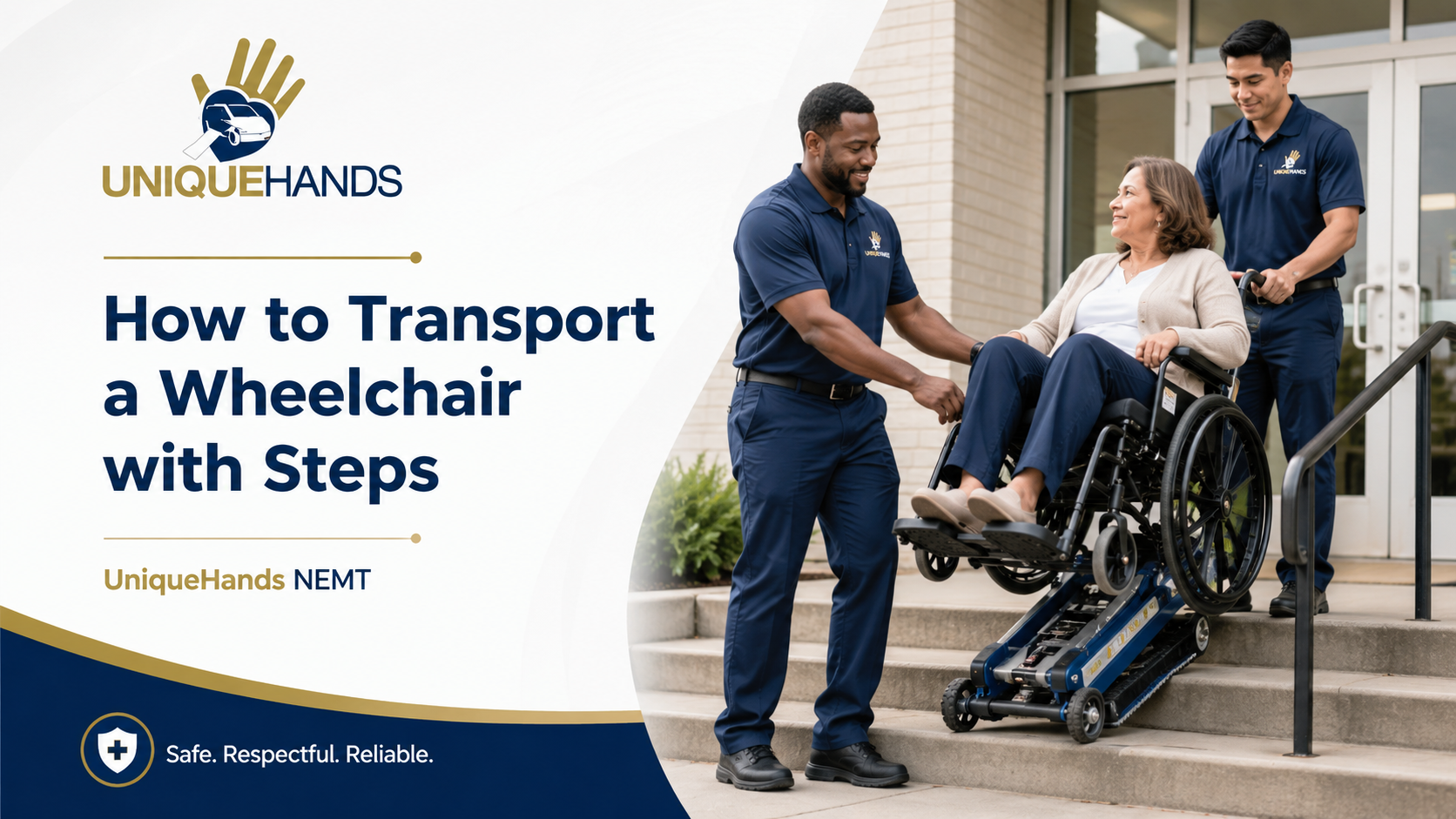
Never attempt to carry an occupied wheelchair up or down steps without suitable equipment, proper training, and an approved transportation plan. A fall can seriously injure the passenger, family members, caregivers, or transportation personnel.
Important safety notice: UniqueHands provides prearranged, non-emergency medical transportation for medically stable passengers. The presence of steps does not automatically mean that transportation can be safely completed. Every request must be reviewed before the trip is accepted.
Why Steps Must Be Discussed Before Transportation
A transportation provider may arrive prepared for a standard wheelchair pickup only to discover several exterior steps, a narrow doorway, a steep entrance, or an inaccessible apartment. These conditions can delay or prevent transportation.
When requesting transportation, tell the provider about accessibility conditions at both the pickup address and destination. Photographs of the entrance may also help the provider understand the environment before dispatching a vehicle.
Information to Provide When Steps Are Present
- The exact number of interior and exterior steps
- Whether the steps are straight, curved, narrow, steep, or uneven
- Whether handrails are available
- Whether an accessible ramp, elevator, or alternate entrance exists
- The width of the doorway and hallway
- The passenger’s approximate weight
- The wheelchair type, weight, dimensions, and whether it is manual or powered
- Whether the passenger can stand, pivot, or walk a short distance with assistance
- Whether the passenger must remain seated in the wheelchair
- Whether family members, caregivers, or facility staff will be available
Option 1: Use an Existing Accessible Ramp
A properly installed wheelchair ramp may provide an accessible route when the passenger needs to remain in the wheelchair. The ramp must be suitable for the height, wheelchair type, combined passenger and chair weight, and available landing space.
Families should not assume that a temporary board, steep portable ramp, or improvised surface is safe. The transportation team must be informed about the ramp before arrival so its suitability can be considered.
Option 2: Use an Elevator or Accessible Entrance
Apartment buildings, hospitals, rehabilitation centers, medical offices, and assisted living communities may have an elevator, loading entrance, service entrance, or another accessible route.
Contact the building manager, facility staff, or security desk before the transportation date. Confirm that the accessible entrance will be open and that the elevator is large enough for the passenger, wheelchair, and necessary assistance.
Option 3: Determine Whether the Passenger Can Transfer
Some wheelchair users can stand, pivot, or walk a few supported steps while others must remain in their wheelchair. A transfer should only be considered when it is appropriate for the passenger and has been clearly discussed in advance.
The transportation provider should know whether the passenger normally transfers independently, requires one-person assistance, uses a walker, or needs more extensive support. Family members should not pressure a passenger to attempt stairs when doing so would be unsafe.
Passengers who can walk with assistance may qualify for ambulatory medical transportation rather than remaining in the wheelchair throughout the trip.
Option 4: Arrange a Different Pickup Location
When an entrance cannot be accessed safely, it may be necessary to arrange pickup from a different location. This could include an accessible building entrance, ground-floor exit, facility lobby, covered loading area, or another suitable location approved by the property or healthcare facility.
The passenger must still be able to reach that location safely. The plan should be coordinated before the vehicle arrives.
When Wheelchair Transportation May Not Be Appropriate
Standard wheelchair transportation may not be appropriate when the passenger cannot remain seated comfortably, cannot safely access the entrance, requires clinical monitoring, or has needs that exceed the provider’s available equipment and assistance.
A medically stable passenger who cannot travel seated may need stretcher transportation. The transportation provider must review the passenger’s condition, weight, building access, and destination before confirming the trip.
How UniqueHands Plans Wheelchair Transportation
UniqueHands provides private-pay, prearranged wheelchair medical transportation for medically stable passengers in Northern Virginia and for approved longer-distance trips.
Before transportation is confirmed, we review the passenger’s mobility, wheelchair type, passenger weight, pickup location, destination, stairs, ramps, elevators, and required level of assistance. Providing complete information helps us determine whether the requested trip can be completed safely.
Explore Related UniqueHands Services
Tell Us About the Steps Before Scheduling
Contact UniqueHands with the pickup and destination addresses, number of steps, wheelchair type, passenger mobility, travel date, and required assistance. We will review the request and explain whether the trip is appropriate for our services.
Frequently Asked Questions
Can an occupied wheelchair be carried down steps?
An occupied wheelchair should not be manually carried over steps unless appropriate equipment, trained personnel, and an approved procedure are available. Improvised lifting can seriously injure the passenger and the people assisting.
Should I tell the transportation provider about one or two steps?
Yes. Even a single step can affect wheelchair access. Report every step, threshold, narrow doorway, ramp, elevator, and accessibility concern before scheduling.
Does UniqueHands install or sell wheelchair ramps?
No. UniqueHands is a non-emergency medical transportation provider. We do not sell or install residential ramps, elevators, or stair lifts.
Can UniqueHands transport a power wheelchair?
Power wheelchair requests must be reviewed in advance. Provide the chair’s dimensions, approximate weight, passenger weight, and any special operating or securement information.
What happens when the entrance cannot be accessed safely?
The transportation provider may ask whether an accessible entrance or alternate pickup location is available. When no safe access plan exists, the provider may be unable to accept or complete the trip.
This article provides general transportation information and is not medical, mobility, construction, or accessibility advice. Transportation suitability must be evaluated according to the individual passenger, equipment, property, and trip conditions.