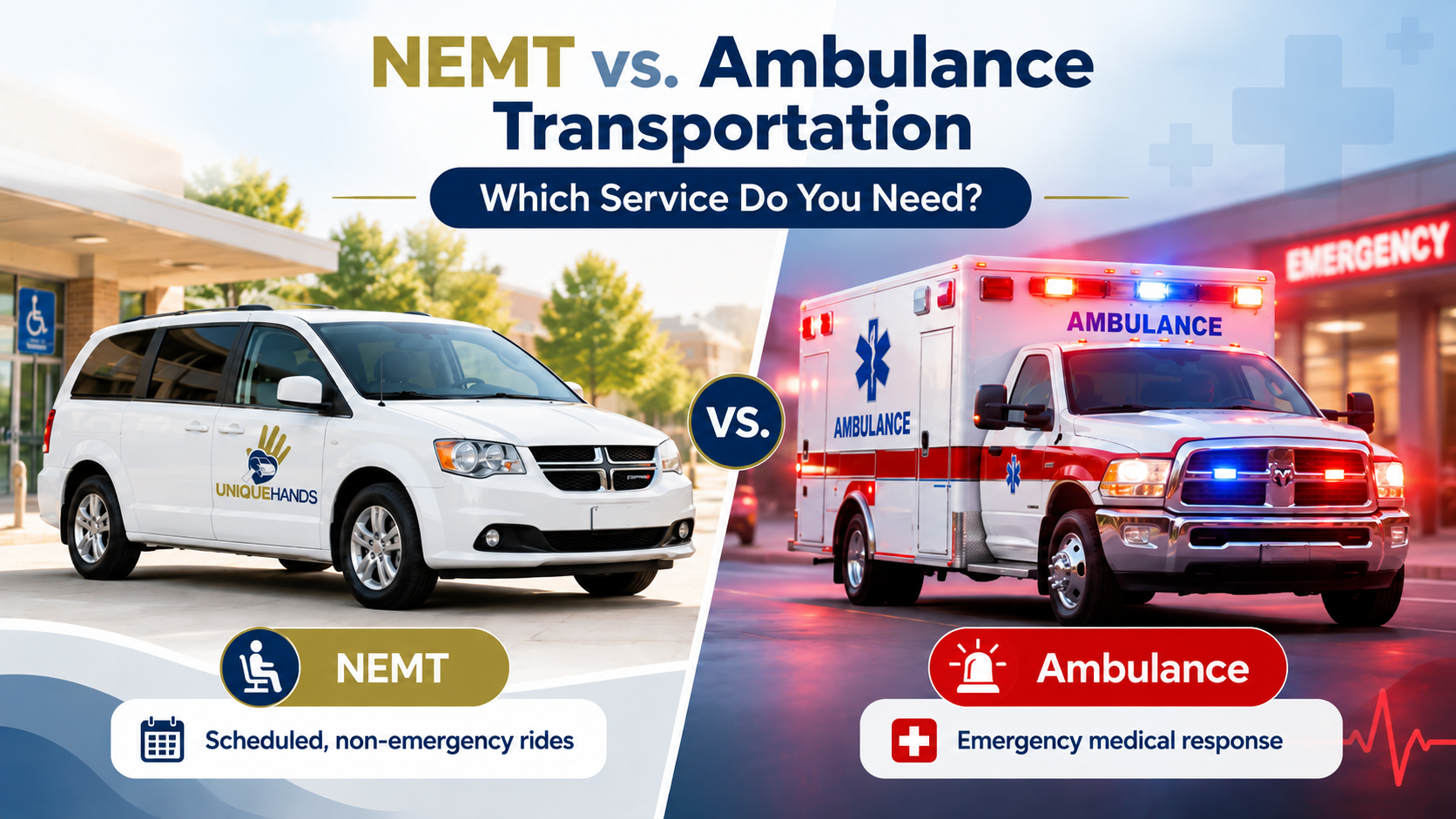

Need Non-Emergency Transportation to the Hospital? Plan Ahead with UniqueHands
Not every trip to a hospital requires an ambulance. Some medically stable passengers need reliable transportation for a planned admission, scheduled procedure, hospital discharge, diagnostic appointment, follow-up visit, rehabilitation transfer, or other non-emergency healthcare need.
UniqueHands provides private-pay, prearranged non-emergency medical transportation for ambulatory, wheelchair, and approved stretcher passengers. Our service is intended for passengers who do not need emergency response or medical treatment during transportation.
Call 911 during a medical emergency. UniqueHands is not an ambulance service. We do not provide emergency response, medical monitoring, medication administration, oxygen management, or medical treatment during transportation.
What Is Non-Emergency Medical Transportation to a Hospital?
Non-emergency medical transportation, often called NEMT, helps medically stable passengers travel to and from hospitals and other healthcare destinations when a standard car, taxi, or rideshare service may not meet their mobility needs.
The trip is arranged in advance and planned according to the passenger’s mobility, wheelchair or stretcher needs, pickup environment, destination, appointment time, and required level of assistance.
Unlike an ambulance, non-emergency transportation is not designed for patients experiencing urgent symptoms, unstable medical conditions, or situations requiring medical care during the ride.
When Non-Emergency Hospital Transportation May Be Appropriate
A scheduled medical transportation service may be appropriate when the passenger is medically stable but cannot comfortably or safely use a regular passenger vehicle.
- Transportation for a scheduled hospital admission
- Transportation home following an approved hospital discharge
- Transportation for a planned surgical or medical procedure
- Transportation to diagnostic testing or imaging
- Transportation between a hospital and rehabilitation facility
- Transportation between a hospital and assisted living community
- Transportation for a follow-up appointment
- Approved long-distance travel to a hospital or treatment center
When You Should Call an Ambulance
Non-emergency transportation should never be used as a substitute for emergency medical care. Call 911 when a person may need immediate evaluation, stabilization, treatment, or medical monitoring.
Examples of emergency symptoms may include:
- Chest pain or pressure
- Severe difficulty breathing
- Signs of a stroke
- Uncontrolled bleeding
- Loss of consciousness
- A severe injury
- Sudden confusion or a major change in condition
- Any situation in which emergency medical attention may be needed
When there is uncertainty about whether the situation is an emergency, contact 911 or follow the instructions of a qualified healthcare professional.
Ambulatory Transportation to a Hospital
Ambulatory transportation may be appropriate for passengers who can walk independently or with limited assistance but should not drive themselves or use a taxi or rideshare service.
This may include passengers traveling for a scheduled procedure, hospital admission, outpatient appointment, or post-procedure pickup when the medical facility permits discharge through a non-emergency transportation provider.
Learn more about ambulatory medical transportation.
Wheelchair Transportation to a Hospital
Wheelchair transportation is intended for passengers who can remain safely seated in their wheelchair during the trip and whose wheelchair is compatible with the transportation vehicle and securement system.
Before scheduling, provide the wheelchair type, approximate dimensions, passenger weight, wheelchair weight, pickup accessibility, number of steps, and whether a ramp or elevator is available.
Learn more about wheelchair medical transportation.
Stretcher Transportation to or from a Hospital
Some medically stable passengers cannot safely remain seated during transportation. Approved stretcher transportation may be appropriate when the passenger must travel in a lying or reclined position but does not require an ambulance or medical treatment during the ride.
The passenger’s condition, weight, mobility, pickup location, building access, destination, and discharge requirements must be reviewed before transportation is confirmed.
Learn more about stretcher medical transportation.
Long-Distance Medical Transportation
A passenger may need to travel outside Northern Virginia for a scheduled hospital admission, specialized treatment, rehabilitation program, family relocation, or transfer to another healthcare facility.
UniqueHands offers approved long-distance medical transportation throughout Virginia and across state lines for medically stable passengers whose transportation needs can be safely accommodated.
Long-distance requests should be scheduled as early as possible so the route, passenger needs, pickup conditions, destination requirements, timing, and pricing can be reviewed.
Information to Provide Before Scheduling
Complete information helps the transportation provider determine whether the trip is appropriate and what vehicle or assistance may be needed.
- Passenger’s full name and contact information
- Pickup and destination addresses
- Appointment, admission, procedure, or discharge time
- Whether the passenger is ambulatory, uses a wheelchair, or needs approved stretcher transportation
- Passenger’s approximate weight
- Wheelchair type, measurements, and approximate weight
- Number of steps at the pickup and destination
- Availability of a ramp, elevator, or accessible entrance
- Whether a caregiver or family member will travel with the passenger
- Any facility instructions or discharge requirements
Planning Transportation After a Hospital Discharge
Hospital discharge transportation should be coordinated with the hospital, passenger, family, caregiver, and transportation provider. Confirm that the passenger has been officially discharged and is medically stable before the transportation provider arrives.
Families should also confirm the discharge location, unit or room number, pickup entrance, estimated release time, mobility needs, destination access, and whether anyone will be available to receive the passenger.
Read our related article: Need Medical Transportation from Hospital to Home? Choose UniqueHands.
Why Families Choose Prearranged Transportation
Appropriate Vehicle Planning
The passenger’s mobility and equipment needs are reviewed before the trip.
Scheduled Pickup
Transportation is arranged around an appointment, admission, procedure, or discharge.
Mobility Assistance
The level of assistance is discussed before the trip is accepted.
Direct Communication
Families and facilities can provide detailed pickup and destination instructions.
Explore UniqueHands Transportation Services
Related Medical Transportation Articles
Schedule Non-Emergency Transportation to a Hospital
Contact UniqueHands with the pickup address, hospital destination, travel date, appointment or discharge time, passenger mobility, wheelchair or stretcher needs, and any accessibility concerns.
Frequently Asked Questions
Can UniqueHands take someone to the emergency room?
UniqueHands may provide prearranged transportation to a hospital for a medically stable passenger who does not need emergency care. Call 911 when the passenger has urgent symptoms, an unstable condition, or may need medical treatment during transportation.
Is UniqueHands an ambulance company?
No. UniqueHands provides non-emergency medical transportation. We do not provide emergency response, clinical monitoring, medication administration, or medical treatment during transportation.
Can UniqueHands pick someone up after hospital discharge?
Yes, hospital-to-home or hospital-to-facility transportation may be available for medically stable passengers when the trip is scheduled and the passenger’s mobility needs can be accommodated.
How early should hospital transportation be scheduled?
Schedule as early as possible, especially for wheelchair, stretcher, hospital discharge, or long-distance transportation. Early scheduling provides time to review the passenger’s needs, availability, route, and accessibility.
Does UniqueHands accept Medicaid, Medicare, or insurance?
UniqueHands currently provides private-pay transportation and does not bill Medicaid, Medicare, or private insurance.
Can a family member travel with the passenger?
A family member or caregiver may be able to accompany the passenger when seating and trip arrangements permit. This should be discussed before transportation is confirmed.
This article provides general information and is not medical advice. Call 911 during an emergency. Transportation eligibility and service availability depend on the passenger’s condition, mobility, equipment, pickup environment, destination, and trip requirements.