How to Choose a Non-Emergency Medical Transportation Provider in Fairfax County, VA
Choosing Medical Transportation Should Start With the Passenger — Not the Vehicle
When a parent uses a wheelchair, a patient is leaving the hospital, or a family needs recurring transportation to medical appointments, it can be difficult to know which transportation company actually fits the situation.
This Fairfax County guide explains what to ask before scheduling non-emergency medical transportation, how to compare services, and which trip details should be discussed before a passenger is ever picked up.
Ask These Questions Before You Book
- Do you provide the transportation type this passenger needs?
- Can you accommodate the passenger's wheelchair or mobility device?
- Do you need to know about stairs or building access?
- How are one-way and round-trip requests handled?
- What happens if an appointment or discharge runs late?
- Can a caregiver or family member travel?
- What information is included in the quote?
- Who should the family call if trip details change?
Already Know What Transportation You Need?
This article is designed to help families compare and evaluate medical transportation. For complete local wheelchair, stretcher, ambulatory, senior, hospital discharge, recurring and long-distance services, visit our main Non-Emergency Medical Transportation in Fairfax, VA page.
Seven Questions That Matter More Than “Do You Have a Van Available?”
Medical transportation works best when the provider understands the passenger and the complete trip before transportation is confirmed.
The Provider Should Ask More Than “Where Are You Going?”
Medical transportation is not ordinary point-to-point driving. The pickup address and destination are only the beginning.
Before a trip is confirmed, the transportation company should understand the passenger's mobility, the pickup environment, equipment involved, requested arrival time and return transportation plan.
Those questions are especially important when the passenger is being discharged from a hospital, lives in a nursing facility, uses a wheelchair or needs transportation after a procedure.
Make Sure You Are Comparing the Same Type of Transportation
A low quote for the wrong transportation type is not a meaningful comparison. Start with what the passenger actually needs.
Ambulatory Transportation
For medically stable passengers who can walk independently or with limited assistance but need scheduled transportation to appointments or procedures.
Ambulatory transportation →Wheelchair Transportation
For passengers who use wheelchairs and need appropriately equipped transportation to healthcare appointments, hospitals or rehabilitation.
Wheelchair transportation →Stretcher Transportation
For qualifying medically stable passengers who cannot safely or comfortably travel seated and need non-emergency lying-down transportation.
Stretcher transportation →Senior Transportation
For older adults who no longer drive or whose mobility, appointments or living arrangement create a recurring transportation need.
Senior transportation →Hospital & Discharge Transportation
Planned transportation for medically stable passengers traveling to a hospital or leaving for home, rehabilitation or another approved destination.
Hospital transportation →Long-Distance Medical Transportation
Transportation planning for qualifying passengers whose care, rehabilitation or receiving destination is beyond Fairfax or Northern Virginia.
Long-distance transportation →Local Knowledge Matters Most When the Appointment Has a Fixed Arrival Time
A medical trip in Fairfax may involve I-66, Fairfax Boulevard, Route 29, Route 50, Route 123, Gallows Road, Main Street or neighborhood roads before the passenger ever reaches the healthcare destination.
When comparing providers, ask how they determine pickup timing for scheduled healthcare — especially when wheelchair boarding, facility check-in or a large medical campus adds time to the trip.
Ask What the Quote Includes — Not Just What the Number Is
Medical transportation pricing can vary because two trips of the same mileage may require very different levels of time, equipment and planning.
The Lowest Price Is Not Useful If the Transportation Does Not Fit the Passenger
Families naturally compare cost, but medical transportation also needs to match the passenger's mobility, destination and appointment requirements.
Before choosing a provider, make sure each company is quoting the same transportation type and understands the same trip details.
A wheelchair trip that includes boarding, securement and a hospital return should not be compared with an ordinary curbside passenger ride as though they are identical services.
Give Every Provider the Same Information
- Same pickup and destination addresses
- Same appointment or arrival time
- Same passenger mobility information
- Same wheelchair or stretcher requirements
- Same building-access details
- Same one-way or round-trip request
- Same waiting or return expectations
Situations That Deserve More Clarification Before Booking
These do not automatically mean a provider is unsuitable. They are simply reasons to ask more questions before confirming the trip.
The Passenger Is Often Not the Person Arranging the Trip
Medical transportation frequently involves families, caregivers, senior communities, nursing facilities, rehabilitation centers and hospital discharge teams.
When Family Is Arranging Transportation
Adult children may coordinate medical transportation for a parent while living elsewhere in Fairfax County — or outside Virginia.
Ask how the provider handles communication when the passenger, person paying for the trip and facility contact are different people.
When a Facility Is Involved
Nursing homes, rehabilitation centers, senior communities and hospitals may have specific pickup areas or staff contacts.
Giving the transportation provider a direct facility contact can make complex pickups and discharges easier to coordinate.
Know How Payment Works Before You Confirm the Trip
UniqueHands provides private-pay non-emergency medical transportation. Passengers, families, caregivers and facilities can contact our team directly to request transportation.
UniqueHands does not bill Medicaid, Medicare or private health insurance.
When comparing providers, ask whether the company is private pay, works through transportation brokers, bills insurance programs or requires another payment arrangement. Understanding that before booking can prevent confusion later.
UniqueHands quotes are based on the actual transportation request, including passenger mobility, transportation type, pickup and destination, distance, accessibility conditions, waiting and return arrangements.
Continue With the Guide That Matches the Passenger
Medical Transportation by Community
Fairfax County trips frequently cross community boundaries. A passenger may live in one city or neighborhood while receiving medical care somewhere else in Northern Virginia.
Main Fairfax Local Page Fairfax Non-Emergency Medical Transportation Start here for complete Fairfax local NEMT service information.Make Sure NEMT Is the Appropriate Level of Transportation
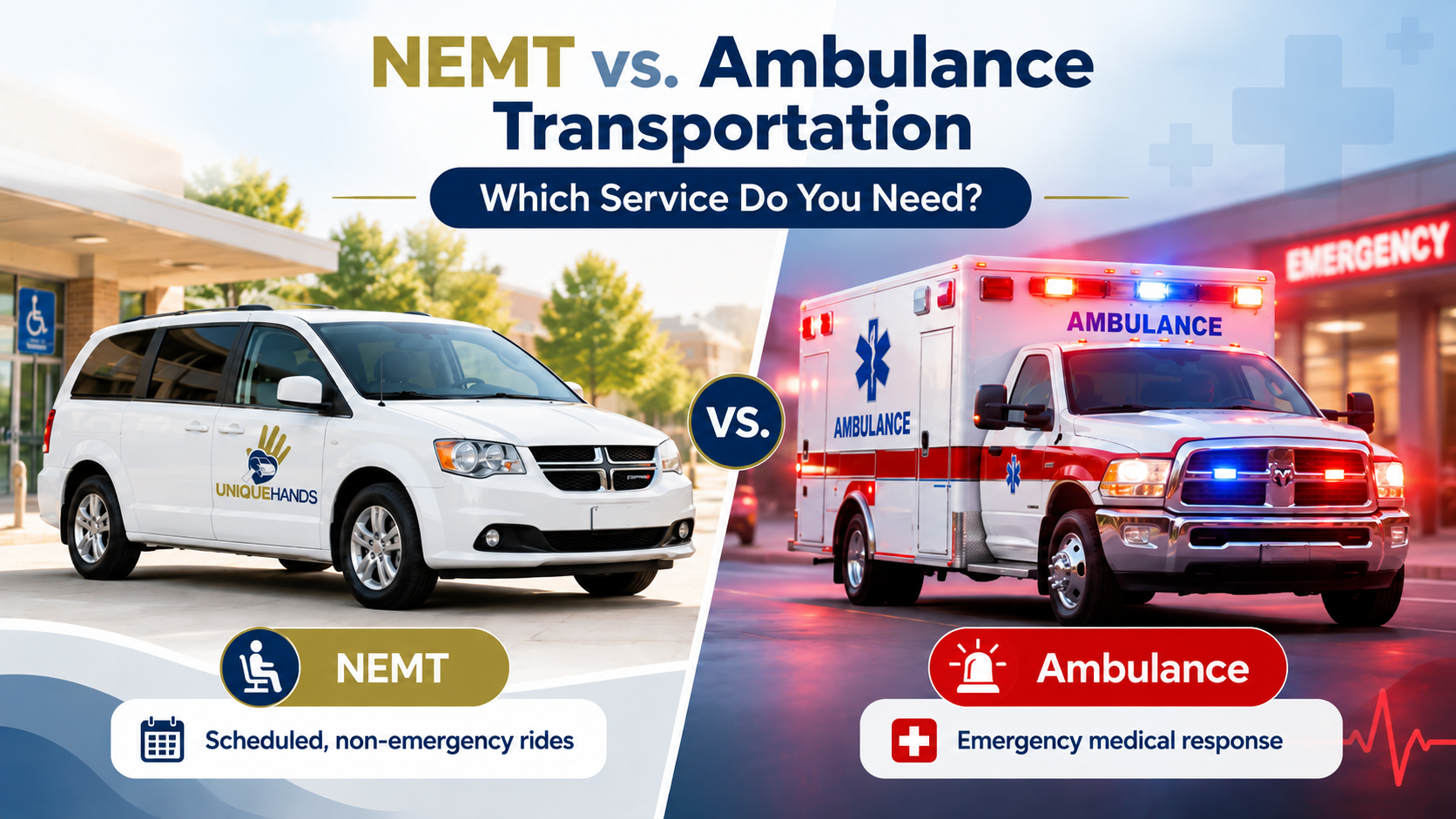
Non-emergency medical transportation is intended for medically stable passengers whose transportation can be scheduled. UniqueHands is not an ambulance or emergency response service. If a person is experiencing a medical emergency, severe symptoms or a potentially life-threatening condition, call 911.
Questions Families Often Ask Before Booking
What should I ask a NEMT provider before booking?
Ask whether the provider can accommodate the passenger's mobility and equipment, how pickup and return timing works, whether stairs or facility access need to be disclosed, how the trip is priced and who to contact if details change.
How do I know whether my parent needs wheelchair transportation?
Consider whether the passenger uses a wheelchair, can safely transfer into a normal passenger seat and can navigate the pickup and destination environments. Explain the passenger's mobility when requesting transportation.
Should I choose the least expensive NEMT quote?
Cost is one factor, but first make sure each provider is quoting the same transportation type and understands the passenger's mobility, access conditions, waiting requirements and return plan.
What should I ask about hospital discharge transportation?
Ask how changing discharge times are handled, which hospital entrance will be used, what mobility the passenger will have at discharge and how transportation to the receiving destination will be coordinated.
Can a family member arrange transportation for someone else?
Yes. Family members and caregivers can request transportation information on behalf of a passenger. Have the passenger's mobility, pickup, destination, appointment and contact information available.
Can a caregiver travel with the passenger?
Companion arrangements depend on transportation type, vehicle capacity, mobility equipment and advance scheduling. Ask about companion travel when requesting the trip.
Does UniqueHands accept Medicaid, Medicare or private insurance?
No. UniqueHands currently provides private-pay medical transportation and does not bill Medicaid, Medicare or private health insurance.
Can UniqueHands provide transportation outside Fairfax County?
Yes. Local and qualifying long-distance transportation requests may be reviewed for destinations elsewhere in Northern Virginia, Virginia or out of state depending on passenger needs and availability.
Comparing Medical Transportation for a Fairfax Passenger?
Tell us the pickup address, healthcare destination, appointment date and time, passenger mobility, wheelchair or stretcher needs, building access and whether the trip is one-way, round-trip, recurring or long-distance.
UniqueHands provides private-pay, pre-arranged non-emergency medical transportation. Transportation is subject to passenger needs, trip review, scheduling and availability. For a medical emergency, call 911.
UNIQUEHANDS RESOURCES
Medical Transportation Articles
Explore practical guides for families, caregivers, and facilities planning wheelchair, stretcher, ambulatory, hospital discharge, long-distance, and state-to-state non-emergency medical transportation.