Medical Patient Transport: Ensuring Safe and Efficient Transfers
Understanding emergency, non-emergency, and air transportation options for patients and families
Medical Patient Transport: Ensuring Safe and Efficient Transfers
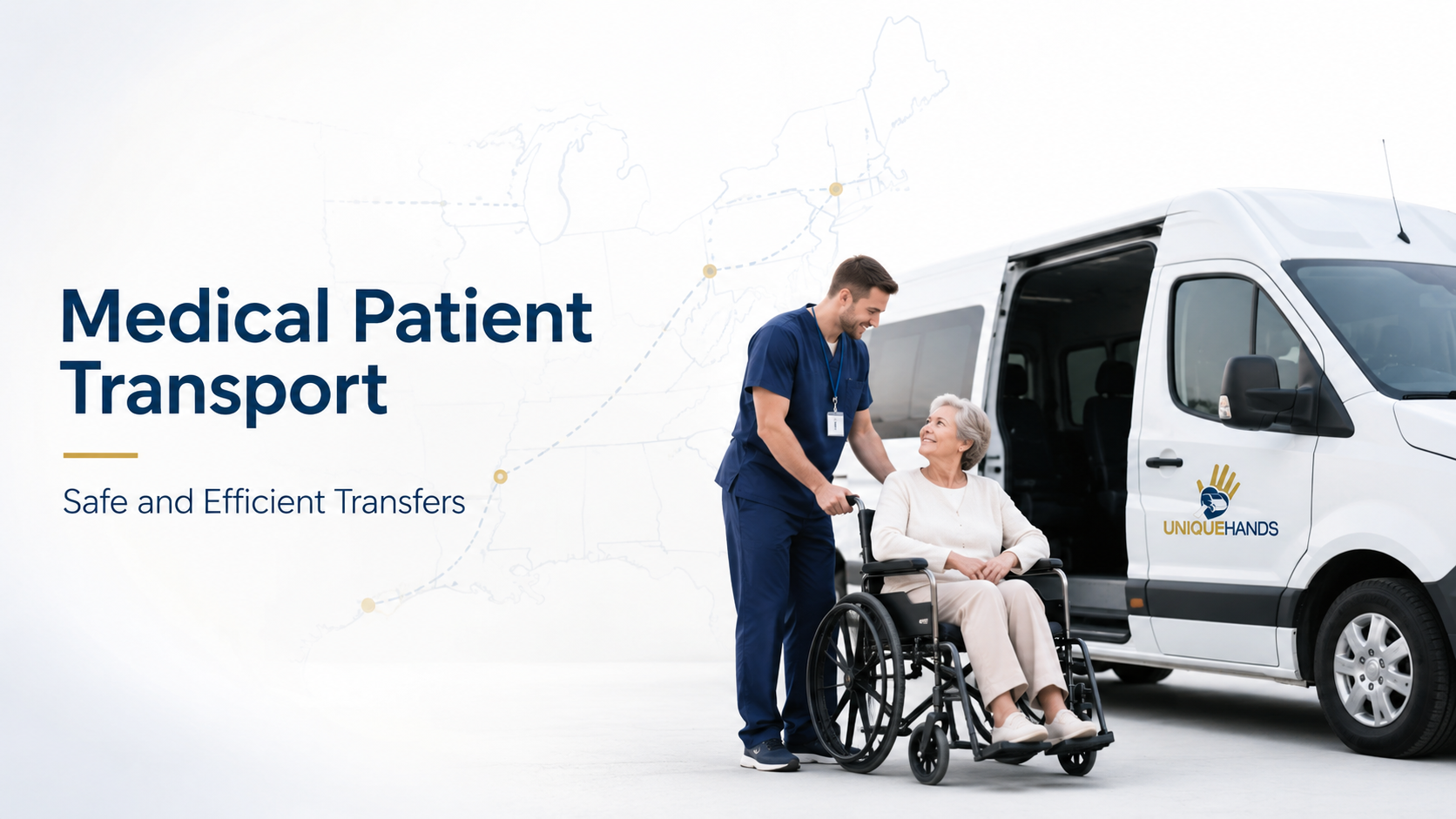
Reliable medical patient transport plays an important role in helping people travel between healthcare facilities or from their homes to hospitals, medical offices, rehabilitation centers, treatment facilities, and other scheduled healthcare destinations.
This type of transportation is particularly important for older adults, wheelchair passengers, individuals with limited mobility, patients recovering from medical procedures, and people whose transportation needs make an ordinary car, taxi, or rideshare unsuitable.
The Importance of Reliable Medical Patient Transport
Reliable transportation helps patients reach necessary healthcare services while reducing the physical and logistical difficulties that can accompany travel. Without an appropriate transportation option, a patient may miss an appointment, delay treatment, or depend on family members who are not equipped to provide the required mobility assistance.
Professional patient transportation can also help families coordinate trips for loved ones who use wheelchairs, need stretcher transportation, have difficulty entering or exiting a vehicle, or require additional assistance from pickup through arrival.
Reliable patient transportation can:
- Support safe and organized movement between locations
- Help patients reach necessary healthcare services
- Accommodate different mobility and positioning needs
- Reduce transportation responsibilities for family caregivers
- Provide an alternative when a standard vehicle is not appropriate
Challenges Faced During Patient Transfers
Transferring a patient can involve more than simply arranging a ride. The transportation provider may need to consider the passenger’s mobility level, wheelchair type, positioning needs, pickup conditions, facility instructions, destination access, and the amount of assistance requested.
Communication is especially important when the trip involves a hospital, rehabilitation center, skilled nursing facility, assisted living community, outpatient center, or another healthcare provider. Delays can occur when discharge paperwork is incomplete, the passenger is not ready, the wrong entrance is provided, or someone is not available to receive the passenger at the destination.
Common patient-transfer challenges include:
- Maintaining passenger comfort during the transfer
- Selecting the correct transportation type
- Coordinating with family members and healthcare facilities
- Making room for wheelchairs, walkers, and mobility equipment
- Planning around stairs, elevators, hallways, and difficult entrances
- Managing changing hospital discharge or appointment times
Understanding Medical Patient Transport
Definition and Purpose
Medical patient transport refers to transportation services that help move passengers between healthcare facilities or from their residences to scheduled medical appointments, procedures, treatments, rehabilitation visits, hospital discharges, or other approved destinations.
The appropriate transportation service depends on whether the situation is an emergency, whether clinical care is required during the trip, the passenger’s mobility and positioning needs, the travel distance, and the type of vehicle required.
The purpose of patient transportation is to:
- Connect passengers with healthcare services
- Provide transportation suited to the passenger’s mobility needs
- Support more comfortable and organized transfers
- Reduce the difficulty of entering and exiting ordinary vehicles
Different Modes of Medical Patient Transport
1. Emergency Ambulance Services
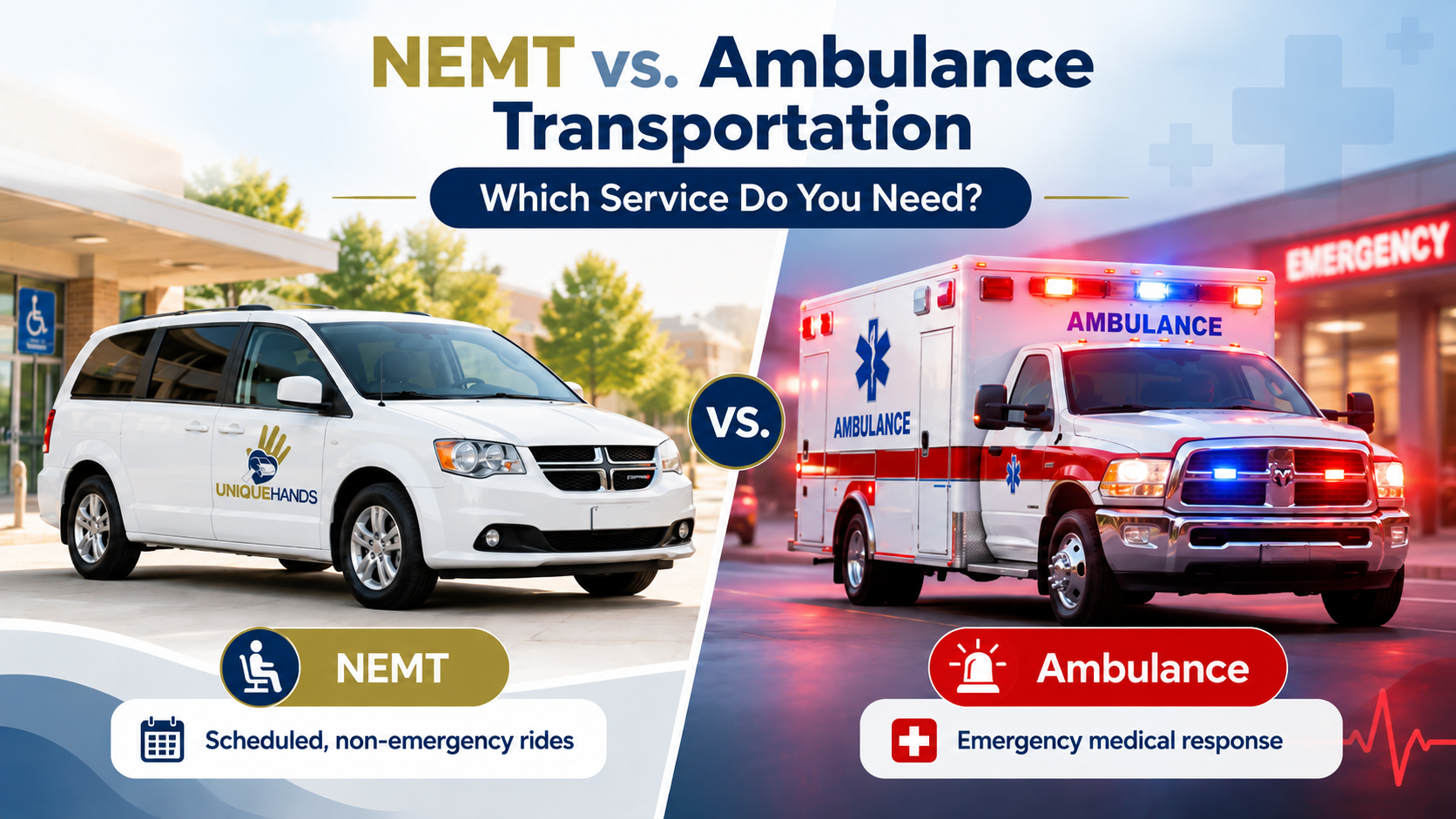
Ambulance services provide emergency transportation for patients who need immediate medical attention or clinical care during the trip. Ambulances are equipped with emergency medical equipment and staffed by licensed emergency medical professionals.
An ambulance may be required when a person is experiencing chest pain, difficulty breathing, severe bleeding, signs of stroke, loss of consciousness, a serious injury, or another urgent and rapidly changing medical condition.
- Emergency medical situations
- Passengers requiring immediate medical intervention
- Situations requiring clinical monitoring during transportation
2. Non-Emergency Medical Transportation
Non-emergency medical transportation is intended for stable passengers who do not require emergency medical treatment during the trip but need a more supportive transportation option than a standard car, taxi, or rideshare.
UniqueHands provides non-emergency medical transportation services for scheduled appointments, treatments, hospital-related travel, rehabilitation visits, procedures, senior care transportation, and other approved destinations.
- Routine medical appointments and scheduled treatments
- Hospital discharges and rehabilitation transfers
- Wheelchair, stretcher, and ambulatory passengers
- Seniors and passengers with limited mobility
- Stable passengers traveling longer distances
3. Air Medical Transportation
Air medical transportation can involve helicopters or fixed-wing aircraft. It may be used when rapid transportation over a significant distance is medically necessary or when a patient must be transported from a location that cannot be reached efficiently by ground transportation.
Air medical providers operate separately from ground-based non-emergency transportation companies. UniqueHands does not provide emergency ambulance or air medical services.
- Time-sensitive long-distance medical transfers
- Certain remote or difficult-to-access locations
- Patients requiring specialized clinical care during flight
Choosing the Appropriate Patient Transport Service
The right transportation option depends on the urgency of the situation and the passenger’s specific needs. Families and care coordinators should confirm whether the passenger requires emergency care, can sit upright, uses a wheelchair, can walk with assistance, or needs a stretcher.
Questions to Consider
- Is the passenger medically stable?
- Does the passenger require emergency medical treatment?
- Can the passenger sit upright safely?
- Does the passenger remain seated in a wheelchair?
- Are there stairs, elevators, narrow hallways, or difficult entrances?
- How far will the passenger travel?
- Will a family member or caregiver accompany the passenger?
When there is uncertainty about whether non-emergency transportation is appropriate, the passenger’s healthcare provider should be consulted before the trip is scheduled.
Frequently Asked Questions
Why is reliable medical patient transport important?
Reliable patient transportation helps people travel safely and efficiently between their homes, healthcare facilities, medical appointments, treatments, rehabilitation centers, and other scheduled destinations. It is particularly important for seniors and passengers with mobility limitations who cannot use an ordinary vehicle safely or comfortably.
What challenges are faced during patient transfers?
Common challenges include selecting the correct vehicle, maintaining passenger comfort, coordinating with family members and healthcare facilities, accommodating wheelchairs or mobility equipment, managing changing discharge times, and addressing stairs or difficult entrances.
What is the purpose of medical patient transport?
The purpose is to help passengers travel between healthcare facilities or from their residences to scheduled appointments and procedures using transportation suited to their mobility, positioning, and assistance needs.
What are the different modes of medical patient transport?
The primary modes include emergency ambulance transportation, non-emergency medical transportation, and air medical transportation. Ambulances are intended for emergencies, NEMT is intended for stable passengers with scheduled transportation needs, and air medical transport may be used for certain rapid or long-distance clinical transfers.
Does UniqueHands provide emergency transportation?
No. UniqueHands provides scheduled non-emergency medical transportation. Anyone experiencing a medical emergency should call 911.
Does UniqueHands accept Medicare, Medicaid, or insurance?
UniqueHands provides private-pay transportation and does not bill Medicare, Medicaid, or private insurance.
Request Medical Patient Transport
Share the passenger’s pickup location, destination, mobility needs, preferred transportation date, and whether ambulatory, wheelchair, or stretcher transportation is required.
Transportation must be arranged in advance and remains subject to trip review, passenger needs, scheduling, and vehicle availability.UNIQUEHANDS RESOURCES
Medical Transportation Articles
Explore practical guides for families, caregivers, and facilities planning wheelchair, stretcher, ambulatory, hospital discharge, long-distance, and state-to-state non-emergency medical transportation.