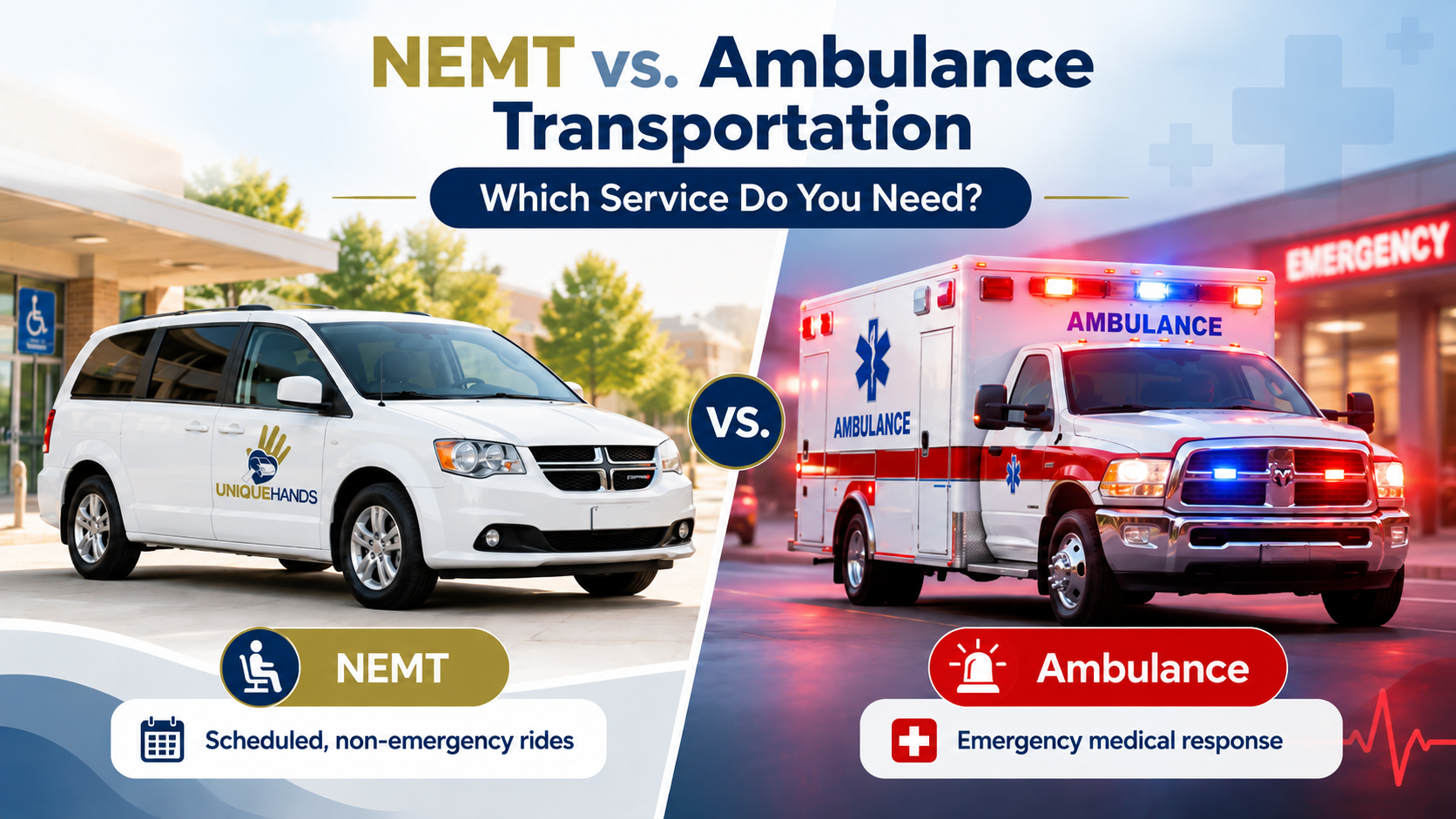
Medical Transport Across the Country: Choosing the Best Option
A practical guide to ambulance, air medical transport, and long-distance non-emergency transportation.

Medical Transport Across the Country: Choosing the Best Option
Arranging medical transport across the country can feel overwhelming, especially when a passenger has limited mobility, uses a wheelchair, cannot sit upright safely, or needs to travel between healthcare facilities. The right transportation option depends on the urgency of the situation, the passenger’s condition, the distance of the trip, the level of assistance required, and the available budget.
The primary options include emergency ambulance transportation, air medical transportation, and non-emergency medical transportation. Each serves a different purpose. Understanding those differences can help patients and families select a transportation method that matches the passenger’s actual needs.
Important: UniqueHands provides scheduled, private-pay non-emergency medical transportation. We are not an ambulance, emergency medical service, or air medical provider. Call 911 when immediate medical attention is required.
Understanding the Different Types of Medical Transport
1. Emergency Ambulance Services
An ambulance is intended for emergencies and situations requiring immediate medical intervention or clinical monitoring. Ambulances are staffed and equipped to respond to urgent medical conditions and transport patients to an appropriate emergency facility.
Emergency ambulance transportation may be appropriate when a person experiences chest pain, difficulty breathing, severe bleeding, loss of consciousness, signs of stroke, a serious injury, or another rapidly changing medical condition.
Although ambulances may provide longer-distance transportation in certain circumstances, they are generally designed for urgent medical transport rather than routine, pre-arranged interstate travel.
2. Air Medical Transportation
Air medical transportation may involve a helicopter or fixed-wing aircraft. This option may be considered when a passenger must reach a distant medical facility quickly, when ground transportation would take too long, or when specialized clinical care is required during travel.
Air medical transportation can reduce travel time over very long distances, but it is generally more expensive than ground transportation. Availability may also be affected by weather, airport access, aircraft scheduling, and the passenger’s medical condition.
3. Non-Emergency Medical Transportation
Non-emergency medical transportation, commonly called NEMT, is intended for stable passengers who do not require emergency medical treatment during the trip but need a more accessible or supportive transportation option than a standard car, taxi, or rideshare.
NEMT can include ambulatory transportation, wheelchair-accessible transportation, stretcher transportation, hospital discharge transportation, rehabilitation transportation, senior transportation, and pre-arranged long-distance trips.
UniqueHands provides long-distance medical transportation within Virginia and to select out-of-state destinations. Transportation is coordinated according to the passenger’s mobility needs, pickup location, destination, trip distance, and scheduling requirements.
Factors to Consider When Choosing Medical Transportation
The Passenger’s Medical Condition
The passenger’s condition is the first consideration. A person experiencing an emergency needs emergency medical services. A stable passenger who does not need continuous medical monitoring may be eligible for non-emergency transportation.
Before arranging a long-distance trip, confirm with the passenger’s healthcare provider that ground non-emergency transportation is appropriate.
Mobility and Positioning Needs
A passenger who can walk independently or with limited assistance may be able to use ambulatory transportation. Someone who must remain seated in a wheelchair requires an accessible vehicle with appropriate wheelchair securement.
Learn more about wheelchair transportation in Virginia and how UniqueHands coordinates transportation for passengers who remain seated in their wheelchairs.
A passenger who cannot sit upright safely may need stretcher transportation. The passenger’s condition and transportation requirements should be reviewed before the trip is confirmed.
Distance and Travel Time
The total distance and expected travel time affect the transportation decision. Ground transportation may be practical for many regional and interstate trips, but extremely long distances may require comparing ground and air transportation.
Families should consider the passenger’s ability to tolerate an extended journey, the need for planned stops, traffic conditions, road conditions, weather, and the time required to reach the destination.
Pickup and Destination Access
Access conditions can significantly affect a transportation plan. Inform the provider about stairs, elevators, narrow hallways, apartment entrances, long walkways, facility check-in procedures, and the location where the passenger must be received.
The pickup and destination should each have a responsible contact who can provide instructions and confirm that the passenger is ready to depart or be received.
Transportation Cost
Transportation pricing may depend on mileage, travel time, vehicle type, wheelchair or stretcher requirements, waiting time, tolls, pickup conditions, destination access, and the level of assistance requested.
UniqueHands provides private-pay transportation and does not bill Medicare, Medicaid, or private insurance. A trip quote should be requested before transportation is confirmed.
When Long-Distance NEMT May Be the Best Option
Long-distance NEMT may be appropriate when the passenger is medically stable but cannot travel safely or comfortably in an ordinary personal vehicle.
- The passenger uses a wheelchair and needs an accessible vehicle.
- The passenger cannot sit upright safely and requires stretcher transportation.
- A hospital or rehabilitation facility is transferring the passenger to another location.
- The passenger is relocating closer to family or moving to another care facility.
- A family member cannot safely drive the passenger over a long distance.
- The passenger needs more assistance than a taxi or rideshare can provide.
Why Families Choose UniqueHands for Long-Distance Transportation
Transportation Based on Individual Mobility Needs
UniqueHands coordinates ambulatory, wheelchair, and stretcher transportation based on the passenger’s mobility, requested assistance, pickup conditions, destination requirements, and travel distance.
Pre-Arranged Trip Coordination
Long-distance trips are planned in advance. The scheduling team reviews the route, estimated travel time, passenger information, transportation type, facility instructions, and vehicle availability before confirming service.
Communication With Families and Facilities
Transportation may involve communication with family members, hospitals, rehabilitation centers, senior living communities, skilled nursing facilities, or another approved destination.
Assistance From Pickup Through Arrival
Depending on the transportation arranged, assistance may include vehicle entry, wheelchair securement, stretcher positioning, exiting the vehicle, and reaching the approved destination entrance.
Tips for a Smoother Medical Transportation Experience
Confirm the Transportation Type
Clearly explain whether the passenger walks independently, uses a walker, remains in a wheelchair, or requires stretcher transportation. Do not wait until the day of travel to disclose important mobility information.
Coordinate With the Healthcare Team
Ask the passenger’s healthcare provider whether ground non-emergency transportation is appropriate. Confirm the expected discharge time, mobility restrictions, destination, and any instructions the family must follow.
Prepare Necessary Documents
Keep identification, discharge paperwork, destination information, medication lists, facility contact details, and other necessary documents together and easily accessible.
Confirm Both Locations
Verify the complete pickup address, destination address, unit or room number, correct entrance, access instructions, and contact telephone numbers.
Schedule Early
Long-distance transportation should be requested as early as possible. Advance scheduling allows time to review the passenger’s needs, route, vehicle availability, pricing, and destination requirements.
Information to Provide When Requesting Transportation
- Passenger’s full name and telephone number
- Complete pickup and destination addresses
- Requested travel date and pickup time
- Ambulatory, wheelchair, or stretcher transportation requirement
- Passenger’s approximate height and weight when relevant
- Wheelchair type and approximate dimensions
- Information about stairs, elevators, hallways, ramps, and entrances
- Pickup and destination contact information
- Whether a family member or caregiver plans to accompany the passenger
Conclusion
Choosing the right medical transport option can make a significant difference in the passenger’s comfort and the family’s peace of mind. Emergency ambulances, air medical transportation, and non-emergency medical transportation serve different purposes and should not be treated as interchangeable services.
For stable passengers who do not need emergency care, long-distance NEMT may provide a more appropriate ground transportation option. UniqueHands coordinates private-pay ambulatory, wheelchair, and stretcher transportation within Virginia and to select out-of-state destinations.
Frequently Asked Questions
What are the primary medical transport options?
The primary options include emergency ambulance transportation, air medical transportation, and non-emergency medical transportation. The appropriate choice depends on urgency, medical needs, distance, mobility, and required assistance.
When is long-distance NEMT appropriate?
Long-distance NEMT may be appropriate for a medically stable passenger who does not need emergency treatment but requires ambulatory assistance, wheelchair accessibility, stretcher transportation, or additional transportation support.
Does UniqueHands provide transportation across state lines?
Long-distance transportation may be available within Virginia and to select out-of-state destinations. Each request is reviewed according to the route, passenger needs, scheduling, and vehicle availability.
Does UniqueHands provide air medical transportation?
No. UniqueHands provides ground-based non-emergency medical transportation and does not operate air ambulances or emergency ambulance services.
Does UniqueHands bill insurance?
No. UniqueHands provides private-pay transportation and does not bill Medicare, Medicaid, or private insurance.
How early should a long-distance trip be scheduled?
Request the trip as early as possible. Advance notice allows time to review the route, passenger needs, transportation type, destination requirements, availability, and pricing.
Request Long-Distance Medical Transportation
Share the passenger’s pickup location, destination, mobility needs, preferred travel date, and required transportation type so the UniqueHands team can review the request.
Transportation must be arranged in advance and remains subject to trip review, scheduling, passenger needs, and vehicle availability.UNIQUEHANDS RESOURCES
Medical Transportation Articles
Explore practical guides for families, caregivers, and facilities planning wheelchair, stretcher, ambulatory, hospital discharge, long-distance, and state-to-state non-emergency medical transportation.