Medical Transportation Long Distance: Safe Patient Travel Across State Lines
Medical Transportation Long Distance: Safe Patient Travel Across State Lines
Long-distance medical transportation helps medically stable passengers travel beyond their local area when a standard vehicle, rideshare, public transportation, or ordinary road trip does not appropriately meet their mobility and transportation needs.

This guide explains how long-distance patient transportation works. For scheduling, trip requests and service information, continue to the main UniqueHands long-distance transportation page.
What is long-distance medical transportation?
Long-distance medical transportation is pre-arranged transportation for medically stable passengers who need to travel beyond their immediate community. Trips may remain within Virginia or cross state lines and can include ambulatory, wheelchair or stretcher transportation depending on the passenger’s mobility needs.
When Ordinary Transportation Is Not Enough for a Long Trip
Traveling several hours for healthcare, rehabilitation, relocation, hospital discharge or a facility transfer can be difficult even for a healthy traveler. For an elderly passenger, wheelchair user, stretcher passenger, or someone recovering from illness or surgery, the trip may require much more planning.
A family vehicle may not accommodate a wheelchair. A passenger may be unable to sit upright for several hours. An older adult may need additional assistance entering or exiting a vehicle. The pickup or destination may have stairs, elevators, narrow hallways or specific admission procedures.
Long-distance NEMT is designed to address these transportation challenges without treating every passenger like an ordinary road-trip traveler.
Who May Need Long-Distance Patient Transportation?
Long-distance transportation may be useful in many situations involving medically stable passengers.
- Older adults relocating closer to family
- Patients traveling to specialty physicians or medical centers
- Hospital discharge transportation over a long distance
- Rehabilitation admissions or discharges
- Skilled nursing facility transfers
- Assisted living or senior community relocations
- Wheelchair users who need accessible transportation
- Medically stable bedridden passengers requiring stretcher transportation
- Ambulatory passengers who need transportation assistance
- Patients traveling to another state for treatment or recovery
- Families relocating a loved one closer to their support system
- Facility-to-residence or residence-to-facility transportation
What Types of Long-Distance Medical Transportation Are Available?
The transportation type should be based on how the passenger can appropriately travel for the entire journey.
Ambulatory Transportation
For passengers who can remain seated and can walk independently or with limited transportation-related assistance.
Ambulatory Transportation →Wheelchair Transportation
Accessible transportation for passengers who need to remain in a wheelchair during extended travel.
Wheelchair Transportation →Stretcher Transportation
Non-emergency stretcher transportation for qualifying medically stable passengers who cannot appropriately complete a long trip seated.
Stretcher Transportation →Can Long-Distance Transportation Be Used Between Hospitals or Care Facilities?
Yes. Long-distance transportation may be needed between hospitals, rehabilitation centers, skilled nursing facilities, assisted living communities, private residences, and other approved destinations.
A facility-to-facility trip requires careful coordination because the departure location may have a discharge process while the receiving facility may have an admission time, required paperwork, room assignment, receiving contact, or specific entrance instructions.
Providing both facilities’ information when scheduling helps the transportation provider understand the complete trip.
Long-Distance Transportation After a Hospital Discharge
A passenger may be medically ready to leave a hospital but still need to travel several hours before reaching home, rehabilitation, assisted living, a nursing facility or family members.
Before scheduling, families should know the expected discharge time, passenger mobility level, transportation type, destination, access conditions and whether someone will receive the passenger at the destination.
The passenger should be medically cleared for non-emergency transportation before departure.
What Should Families Discuss Before a Long-Distance Medical Trip?
Long-distance transportation requires more preparation than a short local trip.
- Passenger mobility. Explain whether the passenger is ambulatory, uses a walker, travels in a wheelchair or requires a stretcher.
- Trip distance. Provide the exact pickup and destination addresses.
- Building access. Report stairs, elevators, ramps, narrow hallways, gated entrances, room numbers and parking restrictions.
- Mobility equipment. Discuss wheelchairs, walkers, stretchers and other items traveling with the passenger.
- Travel tolerance. Consider whether the passenger can appropriately tolerate several hours of non-emergency ground transportation.
- Facility timing. Provide discharge, admission or appointment times.
- Destination contact. Identify who will receive the passenger.
- Companion arrangements. Ask whether a family member or caregiver will be traveling.
- Personal belongings. Discuss luggage and mobility equipment before transportation day.
Why Pickup and Destination Access Matter
The driving distance is only one part of a medical transportation trip. A passenger may need help navigating the pickup or destination environment before or after the vehicle portion of the trip.
Stairs, elevators, ramps, narrow doorways, long hallways, apartment buildings, hospital campuses and facility entrances can all affect transportation.
These details are especially important for wheelchair and stretcher passengers and should be provided before the reservation is finalized.
Can a Family Member or Caregiver Travel With the Passenger?
Depending on vehicle capacity, transportation type and prior arrangements, a family member, caregiver or companion may be able to travel with the passenger.
Companion travel should be discussed during scheduling rather than assumed on transportation day. The provider needs to know how many people will be traveling and whether additional space is needed.
When an elderly or vulnerable passenger needs a family member or caregiver present throughout the trip, including that person in the transportation plan may also make the journey more comfortable.
How Is Passenger Comfort Planned for a Long Trip?
Several hours in a vehicle can be tiring. Families should discuss anything that affects the passenger’s ability to tolerate extended travel, including mobility, positioning, access to personal belongings and whether appropriate breaks may be needed.
Stretcher and wheelchair passengers may have different comfort considerations from ambulatory passengers. That is another reason the transportation type should be identified before the trip rather than on travel day.
Long-distance transportation works best when the passenger’s needs are discussed honestly and completely during scheduling.
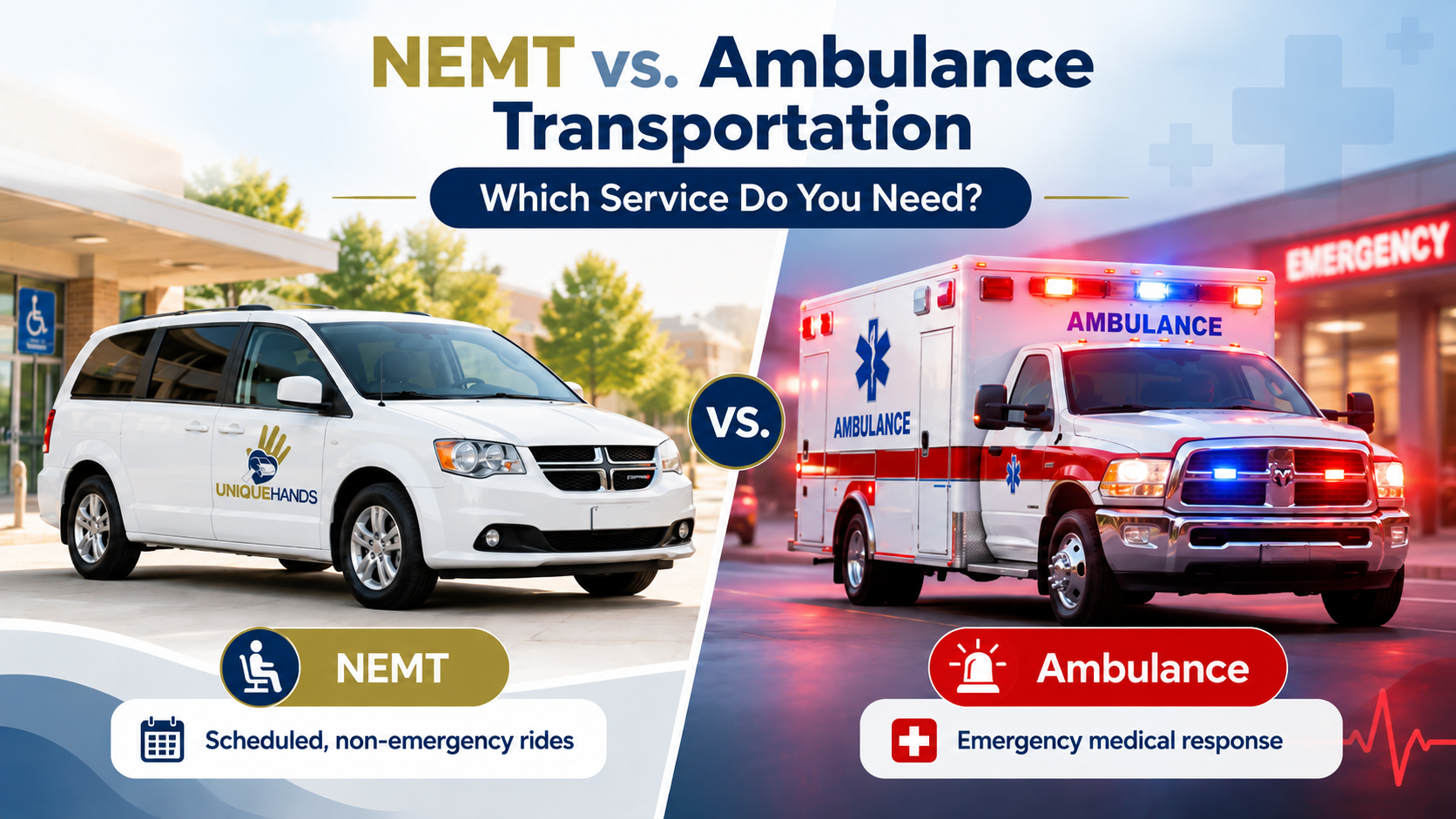
Is long-distance NEMT the same as an ambulance?
No. Long-distance non-emergency medical transportation is intended for medically stable passengers who do not require ambulance-level emergency treatment during the trip.
A passenger who requires immediate emergency treatment, advanced life support, continuous clinical monitoring or another level of ambulance care should use the appropriate ambulance or clinical medical transportation provider.
Can a Non-Emergency Passenger Be Transported to an Emergency Department?
An appropriate medically stable passenger may be transported to an emergency department when ambulance-level emergency response is not required.
If the passenger is experiencing a life-threatening emergency, severe symptoms, rapid deterioration or requires immediate medical intervention during transportation, call 911.
Can Medical Transportation Travel Across State Lines?
Yes. Qualifying non-emergency transportation can extend beyond Virginia when the route, passenger needs, transportation type and scheduling can be appropriately accommodated.
Interstate trips require additional planning because travel time may extend for many hours and both the departure and destination locations may have specific access or facility requirements.
Families researching interstate transportation can also read our state-to-state medical transportation from Virginia guide.
Long-Distance Medical Transportation for Elderly Passengers
Long-distance transportation is commonly requested for older adults who are moving closer to family, relocating between senior communities, leaving rehabilitation, transferring between facilities or traveling for specialty care.
Elderly passengers may have additional mobility, comfort or communication needs that should be discussed before a multi-hour journey.
Read our supporting article about transporting elderly passengers long distance.
How Much Does Long-Distance Medical Transportation Cost?
Long-distance transportation does not have one universal price because each trip is different.
Pricing can depend on mileage, travel time, transportation type, wheelchair or stretcher requirements, pickup and destination accessibility, required assistance, waiting time, tolls, companion travel and other trip details.
Families should provide the exact pickup and destination addresses when requesting a quote so the transportation provider can evaluate the actual route and requirements.
How Are UniqueHands Long-Distance Trips Arranged?
UniqueHands provides private-pay, pre-arranged non-emergency medical transportation. Passengers, families, caregivers, healthcare facilities and senior communities can contact UniqueHands directly to discuss a trip.
UniqueHands does not bill Medicaid or private health insurance directly. Anyone seeking transportation benefits or reimbursement through an insurance plan or assistance program should verify eligibility and coverage directly with that program.
What Should You Ask Before Booking Long-Distance Medical Transportation?
- Do you provide the transportation type the passenger needs?
- Can you accommodate the passenger’s wheelchair or stretcher requirements?
- Can you travel to the requested city or state?
- What pickup and destination access information do you need?
- Can a family member or caregiver travel with the passenger?
- How are long trips and rest stops planned?
- How do you coordinate hospital discharge or facility admission?
- What belongings and mobility equipment can travel with the passenger?
- How is the trip price determined?
- How early should the transportation be scheduled?
- What situations require ambulance transportation instead of NEMT?
Start with the exact pickup, destination and passenger mobility.
UniqueHands can review the route, transportation type, access conditions, wheelchair or stretcher requirements, companion needs and scheduling.
Long-Distance Medical Transportation FAQ
What is medical transportation long distance?
It is pre-arranged transportation for medically stable passengers traveling beyond their immediate local area. The service may include ambulatory, wheelchair or stretcher transportation.
Can medical transportation cross state lines?
Yes. Qualifying interstate transportation may be arranged when the route, passenger needs, transportation type and scheduling can be appropriately accommodated.
How far can non-emergency medical transportation travel?
Trip distance depends on the provider, passenger needs, route, transportation type and availability. Some trips remain within Virginia while others travel to destinations in another state.
Is wheelchair transportation available for long trips?
Yes. Qualifying wheelchair transportation may be used for passengers who need an accessible vehicle and need to remain in their wheelchair during long-distance travel.
Is stretcher transportation available for long distances?
Qualifying medically stable passengers who cannot appropriately travel seated may be transported by non-emergency stretcher service when the trip can be safely accommodated.
Can a family member travel with the patient?
Depending on vehicle capacity, transportation type and prior arrangements, a family member or caregiver may be able to accompany the passenger.
Can long-distance transportation be used after a hospital discharge?
Yes. Qualifying medically stable passengers may use long-distance NEMT after discharge once they have been medically cleared and the transportation arrangement matches their mobility needs.
How much does long-distance medical transportation cost?
Cost depends on mileage, travel time, mobility level, transportation type, accessibility, companion arrangements, waiting time, tolls and other trip details. An exact pickup and destination are needed for a meaningful quote.
How early should interstate medical transportation be scheduled?
Schedule as early as practical, especially for state-to-state trips, hospital discharges, stretcher transportation, wheelchair transportation or facility transfers.
Where can I request long-distance transportation from UniqueHands?
Visit the primary UniqueHands long-distance medical transportation service page or contact UniqueHands with the pickup address, destination, passenger mobility and requested travel date.
Related Long-Distance Medical Transportation Resources
Continue to the service or supporting guide that best matches the passenger’s trip.
Need wheelchair, stretcher or ambulatory transportation over a long distance?
Tell us the pickup location, destination, requested travel date, passenger mobility, transportation type, access conditions and whether a companion will travel.
UNIQUEHANDS RESOURCES
Medical Transportation Articles
Explore practical guides for families, caregivers, and facilities planning wheelchair, stretcher, ambulatory, hospital discharge, long-distance, and state-to-state non-emergency medical transportation.